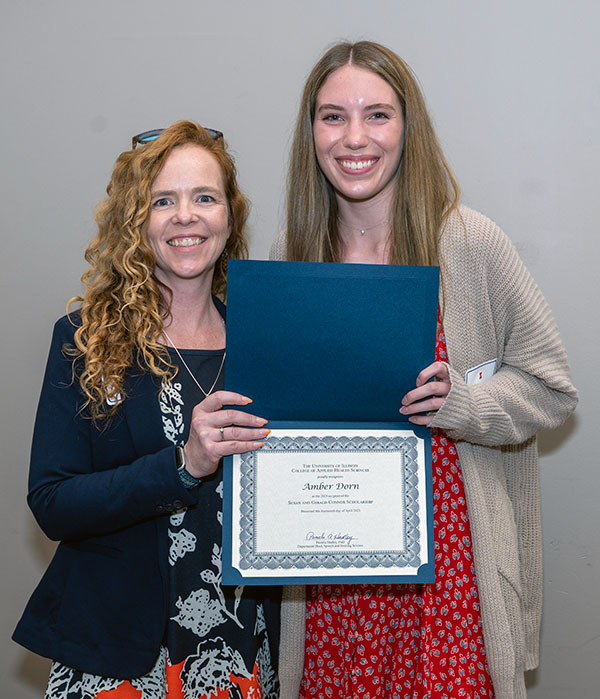
2023 SHS Awards


Related news

SHS undergrad Panfil scores prestigious internship


Holly Panfil knew from a young age that she wanted to support people with disabilities. As she grew up, her passion also grew, and she got involved with organizations that provided her opportunities to work with people who have intellectual or developmental disabilities.

“I had opportunities such as Big Brothers-Big Sisters, where I formed connections with children who communicate nonverbally, and observed their frustrations of not being able to articulate their thoughts,” Panfil said.

Panfil was also part of a Youth Activation Committee, which pairs children with and without intellectual disabilities to teach them how to advocate for the respect, inclusion and
acceptance of all people, regardless of abilities.

“That is what got me started and what made me really passionate about inclusion,” said Panfil, a junior in the Department of Speech and Hearing Science in the College of Applied Health Sciences at the University of Illinois.

In fact, Panfil wanted to be a special education teacher, but her career path took a turn when, as a high school senior, she shadowed a speech pathologist.

“Once I found out there was a career that could work on communication skills and improve those, especially for people that use AAC (Augmentative and Alternative Communication) devices, I just thought that was really cool and something I wanted to pursue,” she said. “Through observing her, it really just didn’t take long for me to realize that this was the career for me.”

And as Panfil pursues a career in speech language pathology, part of her journey includes her plans for the summer. Panfil this winter earned a Fulbright Canada-Mitacs Globalink internship, allowing her to travel to Chicoutimi in Quebec after the spring semester ends. An experience Panfil had last summer led her to apply for the Fulbright.

“Last summer, I worked at an Easterseals camp called Rocky Mountain Village in Colorado,” she said. “It’s a camp for kids and adults with different kinds of intellectual, developmental, or physical disabilities. One week I got to work with a camper who’s 17 and has cerebral palsy and uses an AAC device. I really got to see the issues with AAC devices and her skipping out on parts of conversations because she couldn’t communicate as fast as she wanted to. Just seeing her frustration with that was hard.”

Panfil scanned the Fulbright listings, not expecting to see anything related to speech and hearing science, she said, adding that most research opportunities “seem to be for engineers and computer science majors.”

This time, she was happily surprised. She saw a listing to work with Dr. Julie Bouchard from the University of Quebec at Chicoutimi on the “voice output communication aid uses in the workplace” project.

“Once I saw that there was a project that related to improving AAC devices, I was pretty set on applying,” Panfil said.

With encouragement from her mentor, Dr. Raksha Mudar of SHS, Panfil applied and got the coveted internship. She leaves for Canada in May and will spend the summer working with Bouchard.

“The goal of the project is to learn how VOCA (voice output communication aid) users communicate in the workplace and discover strategies to improve those conversations with coworkers. I will be focused on transcribing and cleaning audio data of VOCA users to prepare it for analysis,” she said.

While Panfil is focused on her work this summer, she is also making plans for the future.

“My plan is to get my master’s in speech language pathology. And I’ve been in the process of researching different programs and trying to narrow down my list … and yes, (Illinois) is on the list, she said. “My time in Dr. Mudar’s lab has made me consider getting a Ph.D. to pursue a career in research. That wasn’t my plan coming into college. I’m hoping that this summer will maybe offer some clarity on that idea.”
 

Editor’s note:

To reach Vince Lara-Cinisomo, email vinlara@illinois.edu.
 

Related news

McCristal recipient Husain has personal connection for her research studies


Most researchers have an inspiration for their research line. It might be an experience, something they read, or even a TV show or movie. For Fatima Husain, it was more personal.

Dr. Husain, a professor in the Dept. of Speech and Hearing Science in the College of Applied Health Sciences, uses a combination of computational modeling, brain imaging experiments, and behavioral experiments to research hearing and speech perception, as well as the disorders associated with them, such as hearing loss and tinnitus.

When she was a Ph.D student at Boston University, Husain said she had a family member who was dealing with a sudden hearing loss.

“I was already thinking about the brain and sounds, and yet I had not come across tinnitus. I remember being in this [ear, nose and throat doctor’s] office and asking questions. ‘And could it be this? Could it be that?’ And you know how some physicians can be, and he said, ‘Why don’t you find out for yourself?”’

So she did.

“I was always trying to find out more about tinnitus,” she said. “I think it took me another five years after that to come to a place where I could start doing research. I started studying in my own time little by little and asking questions. What stood out to me was how little people knew about it. I hope we know more about it now, but still very little is known; compared to even hearing loss, it is very much more challenging and more complicated, which also allows a space for someone like me who is not a clinician, to provide answers and help people.”

That combination of inquisitiveness, persistence and hard work is one of the many reasons Husain is the 2022 recipient of the King J. and Marjorie R. McCristal Distinguished Scholar in the College of Applied Health Sciences, the most prestigious recognition of scholarly achievement given by the college.

Husain joined the Department of Speech and Hearing Science as an assistant professor in 2008. She earned her Ph.D in cognitive and neural systems at BU and joined the National Institute on Deafness and Other Communication Disorders, part of the National Institutes of Health, first as a postdoctoral fellow and then as a research fellow.

At the NIDCD, Husain worked with a researcher who had worked in aging research and was coming to deafness and communication disorders.

“He needed someone who was more interested in sounds than in aging or vision,” she said. “But he kept asking me to be the expert at it. I’m like, ‘What? What do I know?’ But it allowed me to become more independent. The primary reason to move there was to learn brain imaging. I wanted good access to brain imaging, and I wanted good access to people who could teach me how to conduct experiments with brain imaging.”

Husain enjoyed her time at NIDCD, but she missed being in an academic setting. She knew leaving would mean uprooting her family—she had a young child at the time–but took the plunge.

“Academia is high risk, high reward, because of the potential of losing it all if you don’t get tenure. In academia, you have more control over your research direction. But it comes with the risk that you can lose your job too if you don’t get tenure, and then what will you do? I kept telling my husband that, after five or six years, we might have to move. He said, ‘That’s fine, really.’ I’m like, “If I don’t get tenure, I’m just going into industry. And I still know how to program and code. That was my plan B.”

Fortunately, Husain didn’t need Plan B. She wanted a university with “an MRI on campus and stellar imaging facilities.”

“[Illinois] had good access to a tool [the MRI] I needed to advance my research agenda. And then it was the fit of the department and the college. So that mattered too. I needed to work with audiologists. I needed to work with clinicians and other individuals who were ready to partner with me. I wanted to study disorders, and I wanted to do science that did not wait to see outcomes 30 years later. I wanted to see the immediate impact of my work on people’s lives. I don’t know if I achieved that, but that was the goal.”

Judging by the award, Husain has achieved the goal, which obviously has great meaning to her. The King James McCristal Scholar Award was established in 1988 to honor King McCristal, dean of AHS from 1961-1973.

“Every year since I’ve been here, I have attended the McCristal Lecture. I enjoy them enormously. I have always looked up to the individuals who have given these talks. It seemed to me that this is the one award we have which recognizes, at a college-wide level, someone’s scholarship—that they are a good scholar, regardless of their precise field.

“(They) have–both narrowly and broadly–thought deeply about some questions and have tried to answer them, and in the process, have helped try to improve the world. So in that sense it means a lot; it means a lot to me.”

Editor’s note:

To reach Vince Lara-Cinisomo, email vinlara@illinois.edu.
 

Related news

Message from the Department Head, Pamela Hadley


The Department of Speech and Hearing Science concluded an outstanding academic year with the College of Applied Health Sciences Convocation on May 15. We proudly sent many new audiologists and speech-language pathologists into the world, as well as more than 80 bachelor degree recipients who will pursue many different ways of changing the world. It was a wonderful event, all the more so because we were able to celebrate in person for the first time since 2019. You will meet some of our graduates in this newsletter.

We also held our annual recognition of award and scholarship recipients in person in April. More than two-dozen graduate and undergraduate students benefited from the generous support of our donors. They were chosen because of their amazing academic, professional, and personal accomplishments. We were pleased to be joined by friends and families of our recipients, as well as two of the donors who make these awards and scholarships possible, Dr. Ehud Yairi and Mrs. Nanine Breon. It was a very special event, one that made us so proud of our remarkable students.

Our undergraduate students also made us proud with their participation in the 2022 Undergraduate Research Symposium, an event that showcases research excellence across the campus. SHS was represented by 25 students who presented research posters on such topics as factors that improve children’s speech-in-noise recognition, the implications of misophonia for college-age students, and the Lombard effect and speech intelligibility. You can read more about the symposium in this newsletter.

In talking about student achievement, one cannot overlook or overemphasize the importance of outstanding teaching and mentoring. I have always been proud to be a member of the SHS faculty, a committed and caring group of scholars and clinicians who are dedicated to student success. This year, Dr. Raksha Mudar, who serves as our Director of Graduate Studies, received the College of Applied Health Sciences’ Excellence in Graduate Student Mentoring Award, an honor of which she is richly deserving. You’ll learn more about Raksha in this issue of SHS E-News. She is highly valued by students and colleagues alike for her wisdom, patience, and calm demeanor.

SHS was proud to play an instrumental role in the planning and execution of World Voice Day in April, a virtual symposium that addressed vocal health through presentations by our own faculty as well as collaborators from the School of Music, Clarke University, the Mayo Clinic, Universita’ di Bologna, Italy, the New England Conservatory of Music, and the Illinois Applied Research Institute. This interesting and informative event drew a wide and diverse audience, who learned about the importance of the interaction between the voice and the acoustic environment.

We also present a roundup of clinic news in this issue of SHS E-News. We have exciting new programs and services for clients and are truly a one-stop shop for the diagnosis and treatment of communication-related problems.

I hope you enjoy receiving this semi-annual roundup of news from the Department of Speech and Hearing Science as much as we enjoy sharing it with you. Please let us know what you are doing so that we can share news of alumni accomplishments in future issues. You can reach us at alumni@ahs.illinois.edu. Be sure to include your year(s) of graduation and degree(s), as well as a brief description of your professional achievements.

Dr. Pamela Hadley
Professor and Department Head

Related news

For SHS’ Chambers, the plan is ‘an unscheduled life’


Dr. Ron Chambers was one of three sons in a farming family in Texas. His mother always knew that he was the scholar in the family, in love with learning and good at it. She always knew that he would be the first in his family to go to college. He says happenstance led him to careers in audiology and academia, a “good gig” that he has enjoyed for more than three decades and from which he recently retired.

As a student at South Plains Junior College and Texas Tech University, he took a broad array of classes in many different fields, interested in everything. Eventually, the powers that be said, “You have to choose a major to continue your studies.”

“I had taken a course in speech and hearing. I liked it and the instructor encouraged me to stay in the field. So I said, ok!” Dr. Chambers recalled.

He went on to complete a master’s degree in audiology, the maximum degree required at the time for professional practice. He went into clinical practice, but knew he wasn’t finished learning yet. Dr. Chambers had every intention of pursuing a PhD, and he began his work toward a doctoral degree in audiology at Purdue University after just two years of professional practice. He had no intention of becoming a professor, however. He had become fascinated with auditory electrophysiology, which was just gaining strength as a diagnostic technique in clinical audiology. After completing his PhD, he accepted a post-doctoral position at the University of Illinois Urbana-Champaign, joining the Cognitive Psychophysiology Lab of Dr. Emanuel Donchin, a pioneer in the field of cognitive neuroscience.

Dr. Chambers spent a year In Dr. Donchin’s lab, investigating electrophysiological measures of evoked responses in advancing age. When a faculty position opened up in the Department of Speech and Hearing Science, his mentors strongly encouraged him to apply and he said “ok” once again. Thus began Dr. Chambers’ 38-year career in SHS.

Teaching, research, service—all part of the job

Dr. Chambers pursued his interest in measuring electrophysiological brain potentials evoked by auditory stimuli throughout his nearly 40-year career. He has studied the physiologic basis of perceived pitch, the effects of aging on auditory cortical evoked potentials, and the appearance of evoked potentials from both peripheral (brainstem) and central (cortical) auditory structures in individuals with cochlear implants. He participated in some of the earliest work in this area, when cochlear implants consisted of a single electrode that stimulated just one area of the auditory nerve. He also has examined the effectiveness of steady-state auditory evoked potentials in predicting the degree and frequency of hearing loss, and the characteristics of evoked potentials elicited by a relatively new type of acoustic stimulus referred to as the chirp.

“My goal has always been better understanding of the physiologic processing of sound in individuals with normal hearing and those with hearing impairments,” he said. “These evoked brain potentials are common clinical measures now. They enable us to detect hearing difficulties in infants and have an intervention plan in place by the time they’re six months old.”

His research has involved many PhD, AuD, and master’s students and for the last 15 years, his teaching has focused on graduate students. Prior to that, Dr. Chambers also taught a variety of undergraduate classes, and he has always included undergraduates as members of his lab. Working with students will be one of the things he most misses about being a professor.

“I love interacting with students and talking with them about how we hear, the details of auditory processes, how hearing loss affects the quality of life for patients and their conversation partners, and the singular role of audiologists in serving people with hearing loss,” he said. He enjoys seeing all students learn and blossom, he says, and encourages former students to stay in touch.

Dr. Chambers contributed significantly to graduate education in SHS when the required degree for entry into audiology practice was elevated from a master’s to a professional doctorate. Dr. Chambers took charge of creating the Doctor of Audiology degree program in SHS, developing and adding to the existing curriculum courses on the electrophysiological indices of audition, advanced audiologic assessment, hearing conservation, medical audiology, and auditory processing disorders.

“We added a lot more clinical experience, and were able to add courses that went into more depth and addressed more advanced issues than we were able to in the master’s program,” he said. “When students graduate from the AuD program, they’re supposed to be ready to hang up their shingles, and they are.”

He also contributed extensively to the department as an administrator, serving as associate head, acting head, interim head, and head for 11 years. With the support of the College of Applied Health Sciences, which SHS had joined in 1991 from the College of Liberal Arts and Sciences, Dr. Chambers oversaw the growth of the tenure-track faculty as department head. It was during his leadership that the graduate program in audiology transitioned from a terminal master’s to a doctoral degree. He also is proud of spearheading an effort that added courses in American Sign Language to the undergraduate curriculum.

He believes service—to the department, the campus, and the profession—is essential to an academic career, as long as it is kept in balance with teaching and research responsibilities.

“Through these experiences, I learned more about the college, the university, and the professions of audiology and speech-language pathology as vehicles for public health,” he said, “and in the process, broadened my vision and gained greatly in self-confidence.”

Act III

“Somebody asked me what I was going to do in retirement and I said, ‘Have an unscheduled life,’” Dr. Chambers said. “I won’t have to look at a calendar every day. I’ll go with the flow again.”

He said he once read that life has three acts. Act I goes up to age 30, Act II goes through age 60. In both those acts, law of averages willing, you know that when the curtain comes down, it’s going to come back up.

“But when you get to Act III, it’s the final curtain and you never know when it’s going to happen,” he said.  “It’s time to look at other things in the world, a chance to do more reading. Maybe I’ll write a novel.”

Related news
Serving the profession through mentorship


Theodora Papastratakos, left

When students take on their first professional position after completing their master’s degrees in speech and hearing science with a focus on speech-language pathology, they must also begin what is called a Clinical Fellowship Year, or CFY, required by the American Speech-Language-Hearing Association (ASHA) to earn the Certificate of Clinical Competence in Speech-Language Pathology (CCC-SLP). The CFY pairs a first-year practitioner with an experienced practitioner in a mentoring relationship designed to ease the transition between student and independent provider of clinical services.

Theodora Papastratakos completed her master’s degree in 2015 and her CFY during the 2015-2016 school year, her first with Aldrin Elementary School in Schaumburg.

“You dive right in, which is why you have a clinical fellowship supervisor,” she said. “It’s so different from being in graduate school and doing your clinical externships versus managing your own caseload. It’s a big leap.”

She found her own CFY experience positive, but also knew there were things she would have liked to change. During her first several years of practice at Aldrin Elementary, Theo felt she was still learning so much that she could not supervise a clinical fellowship. In the fall of 2021, the department head reached out to her to see if she’d be willing to supervise a new SLP who would be joining the school part time.

“I’d been practicing for seven years, and I think I realized that I do know a lot,” she said. “I was excited to share some of that knowledge with somebody coming into the field.”

She took the training course offered by ASHA and welcomed May 2021 University of Illinois Urbana-Champaign SHS graduate Rachel Deichstetter to Aldrin Elementary as her first mentee. Some of Theo’s role involved just being available to Rachel to answer questions, walk her through district policies and procedures, and give feedback on her ideas.

“I would review her goals and the reports that she was writing and help her as needed,” Theo said. “I watched some of her therapy sessions and gave her feedback throughout the year. If she was experiencing something for the first time, I might help a little bit more. Toward the end of the year, she was practicing independently.”

Theo enjoyed assisting with Rachel’s transition from student to professional and working with someone fresh out of graduate school. “It was fun to see her gain more confidence throughout the year,” she said. “Sometimes when you’ve been practicing for a while, you get stuck in what you’re doing. Rachel brought fresh ideas and new ways of doing things.”

Theo will continue working at Aldrin Elementary while Rachel joins another school in the Schaumburg district for 2022-2023. “I’ll remain a resource for her in the future if she has questions or needs to bounce ideas off someone,” she said. She looks forward to her next opportunity to supervise a clinical fellow and mentor another budding speech-language pathologist into the profession.

Related news

Mudar honored by ASHA Fellowship


In the summer of 2022, Speech and Hearing Science Associate Professor Raksha Mudar was elected a Fellow of the American Speech-Language-Hearing Association (ASHA). Fellowship is one of the highest forms of recognition given by ASHA and is a public declaration of an individual’s outstanding contributions to the discipline of communication sciences and disorders.

The significance of that recognition was not lost on Dr. Mudar.

“I am delighted to receive this honor from the association. To get recognized by the association for these efforts is really personally and professionally fulfilling,” said Mudar, who joined the University of Illinois in 2011. “My journey as a faculty in communication sciences and disorders has been so much fun. I enjoy what I get to do each day, from training the next generation of clinicians and scientists to conducting research examining intriguing questions about the aging brain and neuroplasticity.”

For Dr. Mudar, the ASHA appointment serves as validation for her research agenda, which was inspired by a personal experience.

“When I was an undergraduate student in speech and hearing science (at the University of Mysore in India), a family friend got diagnosed with early onset Alzheimer’s dementia,” she said. “This person was an eloquent storyteller. To watch his cognitive communication abilities deteriorate quickly was difficult to watch. His family struggled to understand his needs and wishes and got little help from his doctors on how to deal with these challenges. I was surprised to find that speech-language pathologists rarely worked with individuals with Alzheimer’s dementia at that time and this inspired me to pursue research on cognitive-communication issues in aging and neurodegenerative disorders.”

According to Dr. Mudar, an ASHA Fellow is expected to support and promote scientific and clinical leadership, interdisciplinary services, and an inclusive culture committed to supporting the needs of those with communication and swallowing disorders.
 
ASHA is the national professional association that sets the standard for professional practice in speech-language pathology  and audiology and serves as an accrediting body. To Dr. Mudar—who was also the AHS recipient of the Excellence in Graduate Student Mentoring award—it represents something more than that.

“(ASHA) offers a great community for members to connect with each other, learn, and build scientific and clinical excellence,” she said. “Furthermore, ASHA’s advocacy in promoting the needs of individuals and families with communication disorders is critical to supporting communication as a basic human right.”

Related news

AHS Get to Know: Laura Mattie, Ph.D.


Photo by caption

How would you describe your primary research interests? 

My primary research interest is learning how young children with neurodevelopmental disabilities develop early social and communication skills to inform parent-implemented early language interventions.

Why did you decide to apply to work at Illinois?

I applied to Illinois because it was one of the only job postings that targeted expertise in children with disabilities and family well-being, which signified that my work was already valued.

What are you working on right now? 

I have 4 main projects right now: 

  • The Power of the Point Project focuses on the predictors of early language development in toddlers with Down syndrome and fragile X syndrome.
  • ASD Screening Tools in Down Syndrome is a large-scale survey of caregivers of individuals 6-18 years old that aims to determine how to best use autism screening tools for this population.
  • The Speech Accessibility Project aims to make voice recognition technology useful for individuals who may have diverse speech patterns and disabilities, including people with Down syndrome.
  • A Foundational Study of Adaptive Behaviors in Individuals with Down Syndrome is a survey of caregivers to learn about the practical, conceptual, and social skills used in everyday life by their children with Down syndrome who are between birth to 22 years old.

What’s a fun fact you’d like to share about yourself? 

I am a twin mom to 15-month-old girls, so much of my free time is chasing after them! When I do have some down time, I enjoy rewatching TV shows like “The Office” and “Parks & Recreation,” reading, and snuggling with our dogs.

Editor’s note:

To reach Ethan Simmons, email ecsimmon@illinois.edu.
 

Related news


Department of Speech and Hearing Science
901 South Sixth Street
M/C 482
Champaign, IL 61820
217-333-2230