April 30, 2026 | Vince Lara-Cinisomo
SHS Department head thanks her parents and mentors for helping reach a career milestone
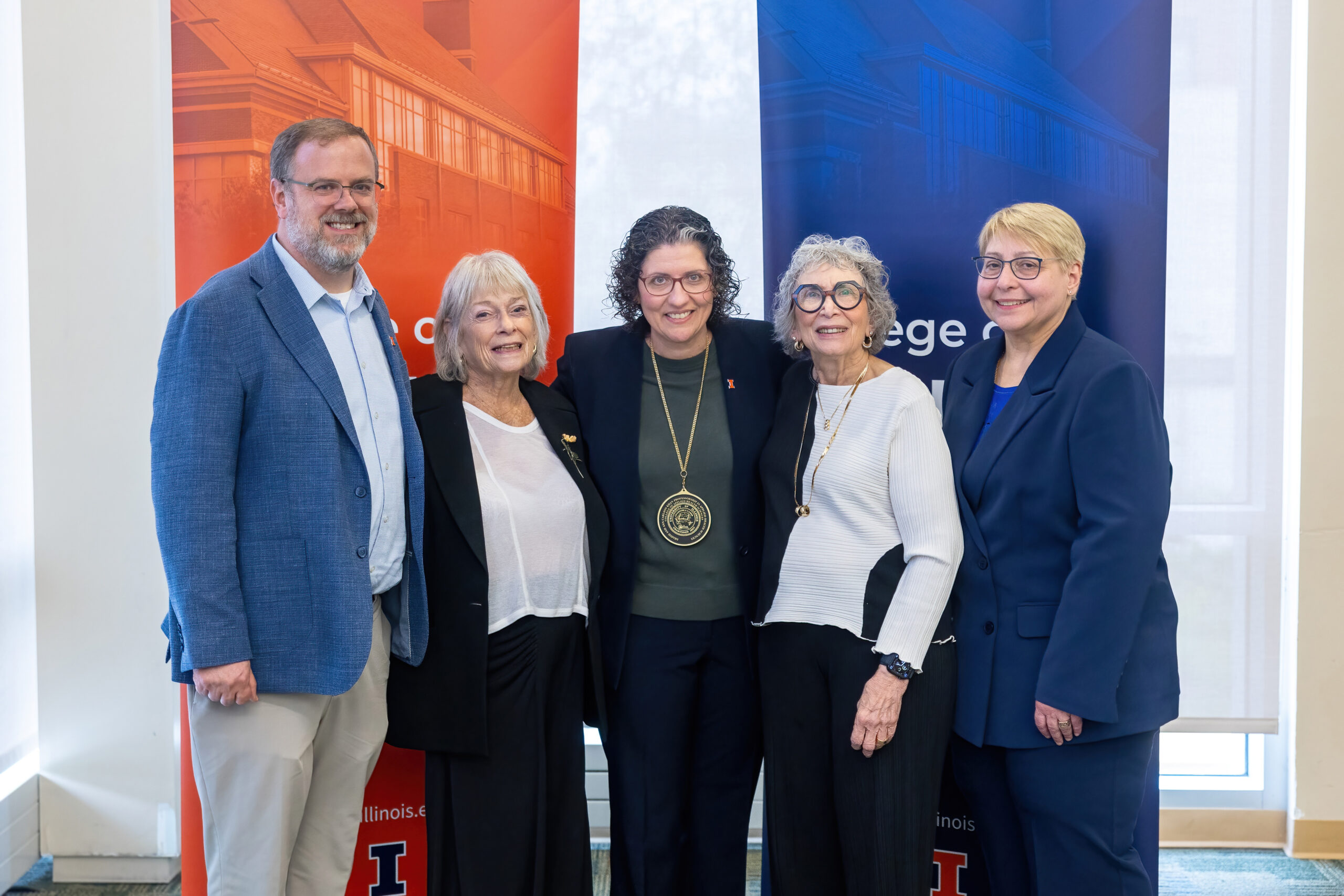
The investiture of Georgia Malandraki as the Shahid and Ann Carlson Khan Professor of Applied Health Sciences was, in many ways, a story about roots and the far-reaching branches they sustain.
Held at Huff Hall, the ceremony brought together university leaders—such as Provost John Coleman—faculty, family, mentors and donors to celebrate Malandraki’s appointment to one of the college’s most prestigious endowed positions. The event underscored both her global impact as a scientist and clinician and the philanthropic vision that made the professorship possible.
“This is a special occasion, not only for our college and university, but for the broader community,” said Cheryl Hanley-Maxwell, dean of the College of Applied Health Sciences. She described endowed professorships as among the most meaningful traditions in academia, recognizing excellence while enabling innovation through donor support.
The professorship is funded by Shahid Khan and Ann Carlson Khan, whose longstanding ties to the university date back to their time as students. Their contributions span multiple colleges and initiatives, including major investments in facilities, academic programs and community outreach.
Shahid “Shad” Khan, who arrived in the United States from Pakistan to study industrial engineering, built a business empire after purchasing automotive supplier Flex-N-Gate. Ann Carlson Khan, who studied business at Illinois, later turned her focus to philanthropy, helping guide the family’s charitable efforts through the Khan Foundation. Together, they have supported causes ranging from education and the arts to healthcare and community development.
“It’s absolutely a joy and a privilege to be here … and all the ideas and thoughts we’ve had (and) what we wanted to do here, and it’s wonderful to see it come to life,” Shad Khan said.
Their gift establishing the Khan Professorship reflects a commitment to advancing research and leadership in applied health sciences. “Because of you, we are able to support leaders like Dr. Malandraki, whose work is improving lives across the globe,” Hanley-Maxwell said.
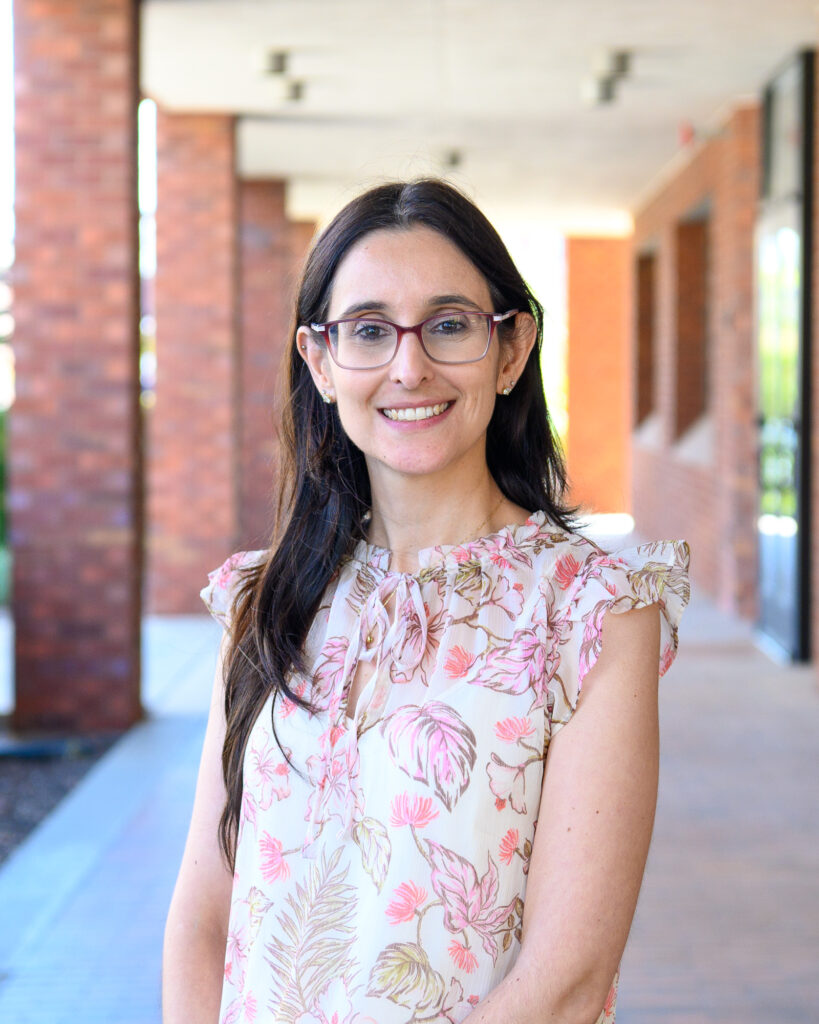
For Malandraki, the honor marks both a professional milestone and a personal homecoming.
An internationally recognized expert in swallowing disorders, she returned in January to her alma mater, Illinois, as head of the Department of Speech and Hearing Science after building a distinguished career at Purdue University. There, she led pioneering work in the Imaging, Evaluation, and Treatment of Swallowing Research Laboratory and Clinic, advancing understanding of how the brain controls swallowing and developing new approaches to rehabilitation.
Her research—supported by the National Institutes of Health and other major funders—has explored cutting-edge interventions, including telehealth and wearable technologies designed to expand access to care. Her work has earned numerous accolades, including the American Speech-Language-Hearing Association’s Early Career Contributions in Research Award and designation as an ASHA Fellow.
Yet in her remarks, Malandraki focused less on accolades and more on the journey that led her to the moment.
“I’m profoundly humble to be given this distinguished honor and opportunity,” she said.
Born and raised in Crete, Greece, Malandraki is a first-generation college student whose path to academia was shaped by family, perseverance and early exposure to the transformative power of education. She recalled leaving Greece in 2002 for the United States with a book gifted by her sister, containing a handwritten Cretan poetic verse (mantinada) that would come to define her outlook: “Tree branches must never forget their roots, for when the roots run dry, the branches wither, too.”
Those roots, she said, began with her parents, Maria and Andreas Malandrakis, who never had the chance to attend college but insisted their children would. Education was not optional in their household; it was woven into daily life.
“My earliest memories are of our family gathered around the kitchen table, everyone studying,” she said. “Reading and education were simply part of daily life. My mother survived World War II as a child. (My parents) raised six children, and I was, believe it or not, the sixth. My mother often joked that raising me felt like raising six more all at once. Despite the issues they faced, including raising me, there was never any debate in our home. Their children would have the opportunities today they themselves did not.”
Tree branches must never forget their roots, for when the roots run dry, the branches wither, too.
Georgia Malandraki
SHS Department Head and ProfessorAnother formative influence was her nephew, Telemachus, who was born when she was 10 years old. Telemachus was diagnosed with autism at a time when speech and support services were scarce. Watching her family navigate those challenges helped shape her decision to pursue speech and language therapy, first in Greece and later in the United States.
“Growing up alongside Telemachus, I witnessed firsthand both his challenges and my family’s determination to support him, an experience that profoundly shaped my career path,” she said.
She earned her bachelor’s degree at the Technological Educational Institute of Patras, followed by a master’s degree from Ohio University and a doctorate from Illinois, making her return to campus especially meaningful.
“This moment is a full circle,” Hanley-Maxwell noted in introducing Malandraki.
Colleagues describe Malandraki as a leader who blends rigorous science with compassion and mentorship. Beyond her research achievements, she has served in key leadership roles, including as president of the Dysphagia Research Society, and is widely recognized for her commitment to evidence-based care and collaborative scholarship.
In accepting the professorship, Malandraki emphasized gratitude and responsibility.
“I accept the Khan Professorship with humility, gratitude and a deep sense of responsibility,” she said. “To my family, mentors, trainees, collaborators and colleagues, thank you for being my roots, my support system and my inspiration.”

She framed the honor not as an endpoint, but as a platform for continued impact, particularly in improving access to care and advancing research that bridges science and clinical practice.
“May our work continue to grow strong branches, deeply rooted in those who came before us, and reaching ever higher toward a future that improves lives,” she said.
The ceremony concluded with closing remarks from Hanley-Maxwell, who highlighted the collective effort behind the achievement, from donors and university leadership to colleagues and family members.
“Dr. Malandraki, congratulations once again,” she said. “We are proud to celebrate your achievements and excited for the impact you will continue to make as the Khan Professor.”
As attendees gathered for a reception following the ceremony, the significance of the moment lingered, not just as a celebration of one scholar’s accomplishments, but as a testament to the interplay of opportunity, philanthropy and purpose.
In the language of Malandraki’s sister’s verse, the investiture honored both the strength of the roots and the promise of the branches yet to grow.
Editor’s note:
To reach Vince Lara-Cinisomo, email vinlara@illinois.edu.