Champaign-Urbana celebrates ‘World Voice Day’


Our vocal folds are roughly the length of our thumbnail, and yet they enable us to speak, sing, laugh and share our favorite stories.  

On April 16, the twin cities of Champaign and Urbana—home to the University of Illinois—will recognize World Voice Day, an international celebration of the human voice that shines a spotlight on vocal health. 

Behind the scenes, both proclamations were driven by clinicians and instructors at the Department of Speech and Hearing Science, based in the College of Applied Health Sciences.

“We wanted to bring World Voice Day to both Champaign and Urbana to raise awareness at the community level and emphasize that voice health is relevant to everyone, not just professionals or individuals already seeking care,” said Mariana Mendes Bahia, assistant professor of speech and hearing science. “Voice disorders can affect anyone in our community, and recognizing this day at the city level helps extend awareness beyond the clinic or classroom.” 

Bahia was inspired by the advocacy of Dysphonia International, an association that supports people with voice disorders. Clarion Mendes, clinical associate professor at SHS, encouraged her to get the day recognized locally. The Department of SHS and officials from both cities were fully supportive. 
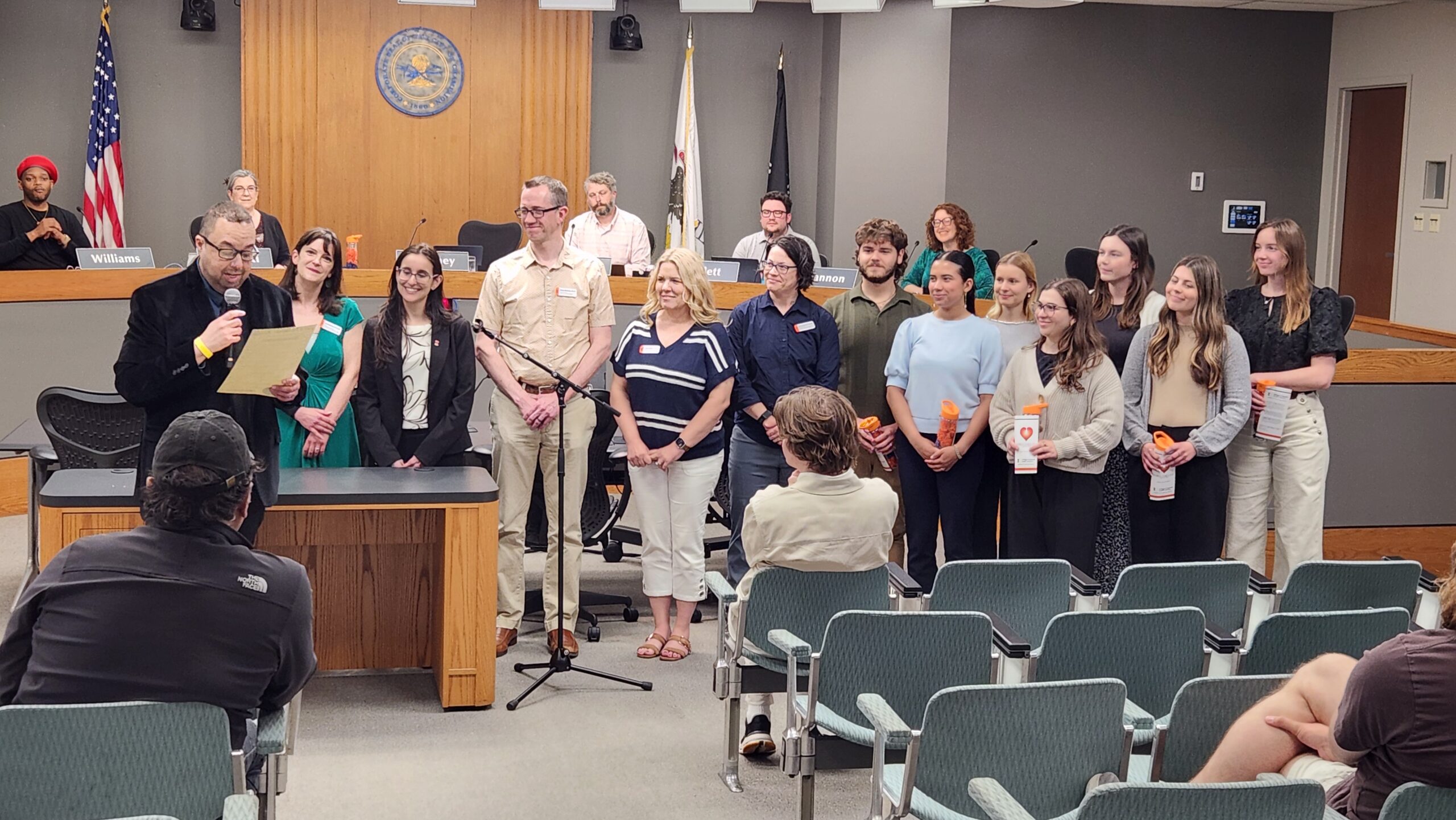
Champaign city council member Matt Gladney reads the World Voice Day proclamation for the city, with Speech and Hearing Science students and faculty in attendance. (Jeff Hamilton | City of Champaign)
  • On Tuesday, April 14, Champaign city council member Matthew Gladney read the World Voice Day proclamation in the city council chambers, with Speech and Hearing Science faculty and students present. 
  • On Thursday, April 16, at 11:15 a.m., Urbana city council member James Quisenberry will come to the Speech and Hearing Science building to proclaim World Voice Day for Urbana, with the whole department in attendance.

A wide range of professions rely on the voice—not just performers. Actors, singers and broadcasters may come to mind, but retail workers, healthcare providers and teachers also lean on their vocal ability and presence every day at work. 
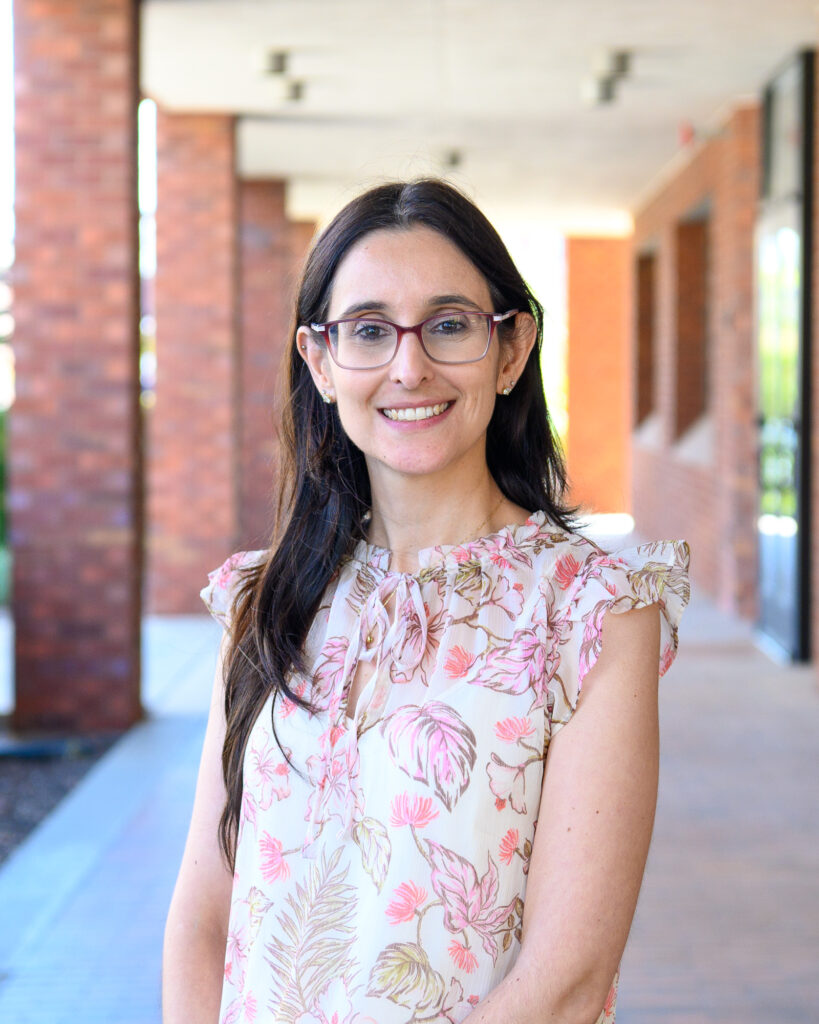
Mariana Mendes Bahia outside the Speech and Hearing Science Building. (Photo by Ethan Simmons | Applied Health Sciences)

And for reasons that aren’t fully understood, the rate of voice disorders appears to be rising in the United States, Mendes said. An estimated 17.9 million adults in the U.S. reportedly experienced a problem with their voice in the last year, according to the National Institute on Deafness and Other Communication Disorders.

“I think of individuals who may not realize the demands they place on their voice, and individuals experiencing voice disorders, for whom communication becomes effortful, limited or even distressing,” said Bahia, who researches swallowing disorders, clinically known as dysphagia.  

To Mendes, World Voice Day is an “extraordinary confluence of art and science,” exciting her students about anatomy and physiology, while showcasing an important part of the speech-language pathology vocation: outreach, education and illness prevention. 

“This day is a reminder that even if we studied and analyzed the voice 24/7, mysteries would still abound, and sometimes we can benefit from taking a pause and simply enjoy the wonder that is the human voice and its capacity for moving us through song or story,” Mendes said. “The Department of Speech and Hearing Science has a legacy of championing the human voice, and it’s incredible to share this with our students and the public.” 

Undergraduate and graduate students in Speech and Hearing Science helped develop educational materials for World Voice Day; explainers on how to protect the voice and when to seek medical attention.

“Our goal is for individuals to better understand how their voice works, recognize early signs of potential problems, and adopt simple habits to protect their voice,” Bahia said. “We also hope these events encourage people to seek care when needed and to view voice health as an important part of overall well-being.”

The Department of Speech and Hearing Science will celebrate “World Voice Day” on Thursday, April 16, at 11:15 a.m. at the Speech and Hearing Science Building.

Editor’s note:

To reach Mariana Mendes Bahia, email mmbahia@illinois.edu.
To reach Clarion Mendes, email cmendes2@illinois.edu.

 

Related news

SHS World Voice Day shows importance of interaction between voice and acoustic environment


Faculty from the Dept. of Speech and Hearing Science were involved in the planning and execution of World Voice Day, a symposium designed to build awareness of the human voice.

Researchers from SHS—including assistant professors Keiko Ishikawa, Brian Monson and Pasquale Bottalico—as well as invited speakers discussed their interdisciplinary projects illuminating voice usage and health.

At the end of the two-hour-plus event, the consensus to achieve voice clarity was: The room matters.

One of the presentations was a collaboration of Bottalico, School of Music Associate Professor Yvonne Gonzales Redman and undergraduate student Natalia Łastowiecka, who worked on a study investigating the influence of room acoustics on singers’ voice production. Clarke University Assistant Professor of Music-Voice Joshua Glasner was also part of the presentation.

The researchers said that similar research on instrumentalists suggests that musical performers may be influenced to some extent by the acoustic environment, and this study demonstrates that singers also tend to adjust their vocal production when in different spaces. Bottalico said singers were recorded singing the same musical selection—Giuseppe Giordani’s “Caro mio ben”—consecutively in five different locations on campus: Smith Memorial Room, Smith Recital Hall, KCPA Great Hall, Colwell Playhouse and the Amphitheater. Voice parameters analyzed were vibrato rate, extent, and pitch inaccuracy. Vibrato extent showed significant changes to the different acoustic environments.

The researchers said to combat any voice problems, singers should train in a variety of spaces, and that future studies should investigate functional causes of aberrant vibrato rate, and investigate how to train singers to adapt to different acoustic environments.

Dr. Ishikawa presented with Diana Orbelo of the Mayo Clinic on the “Vocal health among singers.” Orbelo talked about the importance of gargling, calling it the “rock-star quick fix.” Orbelo said gargling—she recommended water, not beer, as some rock stars preferred—can quickly relax the voice. Ishikawa talked about The Lombard Effect, which is the involuntary tendency of speakers to increase their vocal effort when speaking in loud noise to enhance the audibility of their voice.

Ishikawa said that noisy environments are difficult for anyone to speak intelligibly but they are more difficult for people with voice disorders. Most of these people undergo voice therapy as a part of their treatment, where they learn to use vocal production techniques.

“We wanted to know which technique most effectively improves intelligibility in noise and found twang was the best one, compared to operatic resonant voice and “clear speech,” she said.

“Because noise changes the way people talk—which is the Lombard effect—we thought it would make it difficult for people to use learned therapy techniques. Our recent study showed otherwise, however. People did better with using a technique called “clear speech” when they were hearing the noise. This finding was unexpected and needs further exploration,” Ishikawa said.

Orbelo added that certain sounds, such as twang, as Ishikawa mentioned or talking like a gangster—think Edward G. Robinson In “The Last Gangster”—can help cut through noisy environments.

Monson’s presentation was on the “Directivity of singing voice.” Monson talked about singers’ need to get accommodated to acoustic spaces because they “rely on auditory feedback to regulate vocal output.”

But directivity of a voice matters as much as reflective surfaces because sounds “don’t necessarily go in all directions.”

Other presenters included Dario D’Orazio from the Universita’ di Bologna, Italy, on the “Auralization of soprano;” lan Howell of the New England Conservatory of Music, who presented on “Spectrographic and perceptual analysis of the singing voice,” and Mary Pietrowicz, a Senior Research Scientist at the Illinois Applied Research Institute, presented on “Application of machine learning for voice quality detection among actors.”

Editor’s note:

To reach Vince Lara-Cinisomo, email vinlara@illinois.edu.
 

Related news

Department of Speech and Hearing Science
901 South Sixth Street
M/C 482
Champaign, IL 61820
217-333-2230