SHS freshman Abbie Keasler talks about campus and COVID


Q: Were you on campus?

A: I was not on campus this semester. I studied remotely from home, but my home is not in the Champaign-Urbana area.

Q: What was the deciding factor to stay home, rather than come to campus?

A: There were several factors that influenced my decision to stay home. When weighing all of the variables in my situation, I felt it was best for me to stay home. One thing I contemplated was the money I could save on housing and food by staying home. Another factor was limiting my possible exposure to COVID-19 by staying home. To be honest, I thought universities were not going to keep students on campus for much of the semester. Regardless, I am glad many college students were able to stay on campus until late November!

Q: What challenges did you discover with remote classes?

A: Surprisingly, my remote classes treated me well. But of course, there were difficulties. On my end, there were times when my internet was slow and uncooperative. I didn’t necessarily have any technology issues; the issues I had were rooted in the fact that I was a remote student. It was definitely difficult to find motivation to do my coursework and occasionally challenging to connect with my classmates. I thankfully never had issues with navigating Compass2g or connecting with my instructors.

Q: What are the differences between your high school remote learning experience, and here at Illinois?

A: I did not have much experience with remote learning from my high school before the pandemic hit. My high school did the best they could given the abruptness of the situation, but with my experience at Illinois, it has been similar to the experience I had when I took online dual-credit courses at my local community college. Both institutions utilized an online learning medium that organized assignments, course information, modules, etc. At Illinois, it has been nice to be able to have some virtual face-to-face time with instructors, whether that has been during class or in office hours.

Q: What is the one thing you can’t wait to do when you arrive on campus?

A: I have been asked this question many times! I can’t wait to just simply be on campus! I am looking forward to being in an educational environment with other students, meeting new people in a new atmosphere, and being able to experience the culture and life of University of Illinois and Champaign-Urbana.

Editor’s note:

To reach Vince Lara-Cinisomo, email vinlara@illinois.edu.
 

Related news

SHS Freshman Abby Martinez talks about campus life in the COVID era


Q: Are you on campus?

A: I am on campus!

Q: What made you decide to be on campus?

A: Since it is my freshman year, I thought it’d would be nice to explore campus, get to know more people, and be involved!

Q: What challenges have you found in navigating campus?

A: I haven’t found any. It’s been easy! The buses are always there so I haven’t encountered any problems at all.

Q: What challenges are you discovering with remote classes?

A: With remote classes, expectations are looking a little bit different. Whether it is asynchronous or synchronous learning, having a mix of both is confusing for me. I realize that I am behind in some of my classes when it comes to readings, so I’ve been struggling with that. 

Q: Tell me what you think about the COVID testing process. Has it been easy to find a testing site?

A: I think the process is great! It’s super quick and you don’t have to wait long for your results, so that is definitely a bonus. It has been easy finding a testing site, there’s one not so far from where I am staying at!

Q: What are the differences between your high school remote learning experience, and here at Illinois?

A: When I was in high school, everything was asynchronous learning. Here at Illinois, I have a mix of both. Every one of my instructors have been pretty specific with what they are expecting from us, and the assignments are not confusing at all!

Editor’s note:

To reach Vince Lara-Cinisomo, email vinlara@illinois.edu.
 

Related news

Freshman Brooklyn Clough talks about campus life during COVID-19


Brooklyn Clough (provided)

Freshmen are entering college in a unique environment, and that includes students in the College of Applied Health Sciences at the University of Illinois. The AHS communications staff spoke with new AHS students about campus life, why they decided to come to campus—or stay home—and how COVID-19 is changing their expectations. Today, we speak with Brooklyn Clough, a student in the Department of Speech and Hearing Science.

Q: Are you on campus?

A: I am on campus this semester because even though all of my classes are digital, I believed being on campus would give me the motivation I needed for my classes that I wouldn’t be able to find at home. Also, I wanted the experience; it is only my freshman year so I truly don’t know what I am missing with COVID-19 regulations.

Q: What challenges have you found in navigating campus?

A: Since all of my classes are digital, I don’t travel much on campus, but I do struggle with the bus system. Long story short, I was trying to head to my dorm and ended up in downtown Urbana.

Q: What challenges are you discovering with remote classes?

A: Digital classes have been a complete internal battle because many of my classes are asynchronous as well; So I must organize my schedule on my own and try to remember all of my due dates for different courses. 

Q: Tell me what you think about the COVID testing process. Has it been easy to find a testing site? 

A: Testing has been painless since I live in Nugent, which is connected to the SDRP (Student Dining and Residential Programs) where a testing center is. I also surprisingly have started getting better at finishing the testing faster, since I have been doing it for a while.

Q: What are the differences between your high school remote learning experience, and here at Illinois?

A: My high school remote learning was a lot less motivated than here at Illinois. I did take a remote class in Fall 2019, which was me cramming at the last minute before due dates and after the school went completely digital in spring 2020. I put in little effort because our grades couldn’t be negatively affected if we showed active participation. Here at Illinois, these classes matter and are important; However, it is quite similar in that I have few check-ins and mostly work is on my own.

Related news

Grant to help researcher study difference in hearing for preterm babies


Brian Monson in his office (Credit: Brian L. Stauffer)

A researcher in the Department of Speech and Hearing Science in the College of Applied Health Sciences has received funding to determine the difference in language exposures for preterm infants relative to what they would be hearing if they were still in the womb. 

SHS assistant professor Brian Monson earned a $300,000 grant from the National Institute of Deafness and Communication Disorders for his project entitled, “Auditory experience during the prenatal and perinatal period.”

Monson said the aims of the project include comparing typical fetal auditory exposures in the womb to preterm infant auditory exposures in the neonatal intensive care unit, and assessing the effect of these exposures on auditory neurodevelopment. The study, he said, is being conducted in collaboration with Carle Hospital, with the long-term goal of optimizing auditory exposures for preterm infants to foster healthy brain development in the neonatal intensive care unit.

“We also hope to see whether these differences in exposures have an effect on later brain and language development,” Monson said.

The grant from the NIDCD—which is part of the National Institutes of Health—helps extend upon research Monson undertook with funding from a Center for Health, Aging & Disability (CHAD) pilot grant.

Monson said the plan is to enroll 100 preterm infants and 100 pregnant women who carry to full term, with recruiting done locally of pregnant women from the Champaign-Urbana community and NICU patients from Carle Hospital. He said data collection had begun and that he had about 30 subjects in each group.

Once differences between exposures in the NICU vs. the womb are established, Monson said, the next step would be to develop an intervention that enhances NICU auditory exposures (e.g., by increasing language exposure) and assess the effects of this intervention with a clinical trial.  “We also plan to continue following up with the current study’s babies later in childhood,” he said.

“One out of every 10 babies born in Illinois is born premature, which is similar to the national rate,” Monson said. “Because of this, we feel this project is critically important as it will lead to improved health outcomes for our community’s tiniest human beings.”

Editor’s note:

To reach Brian Monson, email monson@illinois.edu.
 

Related news

Mattie gets grant to study children with fragile X syndrome


Speech and Hearing Science Department assistant professor Laura Mattie is launching a study in August in hopes of developing ways to help children with fragile X syndrome communicate better.

Mattie received a grant of $454,977 over three years from The National Institute on Deafness and Other Communication Disorders (NIDCD), part of the National Institutes of Health, aimed at identifying the contribution of child and maternal gestures and responsive maternal language input to word learning opportunities, production practice, and spoken vocabulary growth for toddlers with fragile X syndrome (FXS).

Fragile X syndrome is an inherited genetic condition that causes a range of developmental delays, including learning disabilities and cognitive impairment. Affected individuals usually have delayed development of speech and language by the age of two.

Data collection will start on Aug. 1, Mattie said, and take place across the country.

“Fragile X syndrome is a rare neurogenetic disorder, so that means we will go to where the families live to collect the data,” she said. “It is easier for us to travel because the child participants are all toddlers.”

While existing research in FXS has revealed impairments in child gesture use, Mattie says in her abstract describing the study, no studies to date have examined the link between gesture use and the onset of first words prospectively.

“Our long-term goal is to develop and evaluate early language interventions for these children,” she said.

The term maternal language input is more than just a mom saying a word, and a child repeating it, Mattie said. “High-quality input involves what mothers are saying and how they use non-linguistic cues like gesture to connect their words to the objects children are playing with,” she said. “The timing of spoken words with the gesture cues also play a role in language learning.”

The study will involve toddlers with FXS and their biological mothers completing three assessments over a one-year period starting when the child is between 18 and 24 months. The mother and toddler will be observed to measure child gesture use, child vocabulary, and maternal gesture use and language input.

The ultimate goal, Mattie said, is helping children with FXS communicate. “It will improve their interactions with others in the community and helps with independence,” she said.

The next step for Mattie is conducting cross-syndrome comparisons between children with FXS and children with Down syndrome. A recent pilot grant from the Center on Health, Aging & Disability (CHAD) has allowed Mattie to examine similar skills in children with Down syndrome.

“Together these studies will support my long-term goal of designing early language interventions that build on the strengths of each population,” she said. “Early interventions have long-term and lasting effects on the outcomes of those who receive them.”

Editor’s note:

To reach Vince Lara-Cinisomo, email vinlara@illinois.edu.
 

Related news

Rogers, Mudar receive $4.6M grant to establish center focused on older adults with cognitive impairment


The University of Illinois is part of a team receiving a $4.6 million grant aimed at helping adults with cognitive disabilties deal with challenges associated with everyday activities.

The grant from the National Institute on Disability, Independent Living, and Rehabilitation Research runs from Sept. 30, 2019 to Sept. 29, 2024 and is a collaborative effort with Weill Cornell Medicine and Florida State University, with Illinois’ share amounting to approximately $1.4 million.

Kinesiology and Community Health professor Wendy Rogers and Speech and Hearing Science associate professor Raksha Mudar are the principle investigators on the research for Illinois. Harshal Mahajan, assistant research professor of Kinesiology and Community Health, is also an investigator on the project.

The funding is for a Rehabilitation Engineering Research Center entitled ENHANCE (Enhancing Neurocognitive Health, Abilities, Networks, and Community Engagement).

Rogers and Mudar said the primary research aims are to understand challenges adults with cognitive disability deal with every day, and to identify existing and emerging technology that can help. Three segments of the population are part of the study group: Adults 60 and older with mild cognitive impairment, cognitive impairments due to stroke and those who have sustained a traumatic brain injury.

“What we’re trying to do is understand the challenges that they experience in their daily activities,” Rogers said. “In one study, we’ll be interviewing them about what they do outside the home, what they do around the home; shopping, transportation, health, finances and then just basic daily activities, such as mobility and medication regimen.”

Rogers said the study’s participants will include both the the individuals with cognitive disability as well as their family members who provide support and care. They will be exploring whether needs change over time, with interviews repeated across the five-year project.

“Really, we’re trying to get an understanding in general of people with cognitive disability on an everyday basis, what kind of challenges are they experiencing and how might we design technology to support that.”

Another goal is understanding what this population uses in terms of current technology to mitigate their impairments.

One of the projects, Rogers said, involves helping adults with cognitive disability use Google Maps and rideshare apps, through additional instructions and support, which could include an app on their phone that walks them through steps, or a video that illustrates what to do and helps them as they learn.

Mudar explained that they also plan to engage healthcare providers and the technology industry in hopes of developing partnerships.

Editor’s note:

To reach Vince Lara-Cinisomo, email vinlara@illinois.edu.
 

Related news

A Quiet Place


Baseball Hall of Fame member Yogi Berra once famously said, “It’s so crowded, nobody goes there anymore.” For restaurants, it’s not the crowd but the noise that drives people away.

That’s what Dr. Pasquale Bottalico is trying to mitigate with his research.

Dr. Bottalico, an assistant professor in the department of Speech and Hearing Science in the College of Applied Health Sciences, had his study, “Lombard effect, ambient noise and willingness to spend time and money in a restaurant,” published in The Journal of the Acoustical Society of America in September 2018.

The Lombard effect describes the unconscious attempt speakers make in noisy environments to maintain a level of speech that allows them to be understood. The objective of Dr. Bottalico’s study was to determine the minimum level of noise in a restaurant that initiates the Lombard effect.

Restaurant noise is a common complaint for diners, with some 25 percent saying they consider noise to be the most irritating component of eating out, according to a Zagat survey cited in the study. Using his undergraduate students, Dr. Bottalico simulated a restaurant setting in one of the SHS sound booths.

“We used typical restaurant noise and we changed the level in a random way … from a medium level to a very loud level,” he said.

What Dr. Bottalico found was that subjects reported a disturbance of their speech when noise reached 52.2 A-weighted decibels (dBA) and that vocal effort began to increase at 57.3 dBA. The sound level of speech increased as ambient noise increased. As background noise increased, it triggered a decrease in the willingness to spend time and money in that establishment.
 
“After dinner, your throat is sore and you don’t understand why,” he said. “But the Lombard effect is an unconscious effect, so you are not conscious of the fact that you are actually screaming.

“But your voice, your body and your physiology knows that. And I found that this particular effect was never studied in a restaurant and they were not studying it, correlating with the willingness to spend money.”

The Turin, Italy-born professor had done similar studies in the past understanding other aspects of the Lombard effect, including in classrooms, where the object was to construct the perfect learning environment in terms of how sound reverberates from the instructor speaking to the students.

What Dr. Bottalico found was that many classrooms in Europe had much slower reverberation times than in the United States, which led to sounds overlapping and much less clarity of what was being said, thus hampering comprehension by students.

Armed with that data, he was particularly interested in how it translated in other settings, especially after seeing how it dovetailed with restaurants and a declining bottom line.

“I used a similar protocol, but I changed the setting and I changed the noise,” he said.

Dr. Bottalico concluded that restaurants should have ambient noise levels of 50 to 55 dBA – a level much lower than current restaurants.

He said when restaurants eclipse that figure, “it was starting to [indicate] a willingness to leave that place and also to spend less money to eat in that place. It was starting to create a disturbance in the communication.”

A passion for music and voice  

That disturbance is something Dr. Bottalico assiduously attempts to avoid. A trained opera singer who studied music and engineering at two different universities in Italy at the same time, he was in tune at an early age.

“I come from a family that very much loves music,” he said. “But my parents come from a very blue-collar family so they didn’t have the opportunity or the time to study music when they were kids. I remember in my house there was always music playing and my father in particular was very attracted to classical music and opera. So I grew up learning about opera without knowing I was doing that.”

Dr. Bottalico earned his PhD in Metrology, studying acoustics with particular attention to the uncertainty of measurements and statistical analysis of data. For his dissertation, he investigated classroom acoustics.

The transition from music to his current vocation was seamless, Dr. Bottalico said, because when you’re a vocal performer “you need to understand the internal mechanisms you are using. When you are a voice student, it is an obsession because it is not like other instruments, when you can see what you are doing. If you are a piano player, and you have a hard passage, you will keep practicing that passage until your fingers are moving automatically and you are able to do that particular passage.”

He is particularly interested in the professional voice user and singer techniques, as well as the definition and the quantification of vocal load.

Vocal performers, he said, “cannot study too much because you are your vocal instrument so you need to be very careful.”

Because of that, he is sensitive to what straining to be heard — whether it’s in a restaurant or other setting — can do to a voice.

Taking next steps and finding solutions

Dr. Bottalico is treating this published study as a pilot and hopes to expand it to focus on an elderly population, especially since Champaign-Urbana is positioning itself as aging-friendly.

“I have a doctoral student in audiology and she’s going to start to collect data next semester,” he said, “and the goal will be to create a different group with normal hearing and people with a moderate hearing loss and people with severe loss and try to understand better how this vulnerable population is affected by the problem.”

He said interventions for restaurants with noise problems range from easy to complicated arrangements, but brought up a pizza chain in London that employs domes over tables that keep conversation in and noise out, although the disadvantage is you cannot easily move the tables.

Another restaurant in Los Angeles uses an array of microphones in the ceiling that record noises in real time. That technique allows for a static noise environment that is not dependent on the number of patrons.

“So I’m controlling the reflection by means of artificial acoustics and I can do whatever I want with it,” he said.

Changes can be as easy as changing a tablecloth to muffle sound.

“It’s just a matter of being aware of the problem, and wanting to find a solution.”

If there is a solution to be found, you can be assured that Dr. Bottalico’s voice will be heard.

Editor’s note:

To reach Vince Lara-Cinisomo, email vinlara@illinois.edu.
 

Related news

Renovating for the Future


Conducting 21st century research and instruction in 20th century space can be challenging. Architects designing buildings 40 to 100 years ago could never have imagined the scope of the investigations in which faculty would be engaged, from the macro to the molecular level. Nor could they have predicted with any accuracy how departments would grow and change over the years.

Take the Women’s Gymnasium, for example.

An ambitious plan

Built in the early 1930s, what is now known as Freer Hall provided expanded facilities for the women’s physical education department, which had outgrown its space in the Woman’s Building (now the English Building). The last of 11 Georgian-style buildings on the Urbana-Champaign campus designed by renowned architect Charles Platt, the Women’s Gymnasium housed administrative offices, classrooms, and gymnasium spaces that were used for recreation, intramural sport competitions, and physical education research. Louise Freer, the women’s physical education director for whom the building was later renamed, added a lounge area in 1932 to provide a social space in the building.

The original design called for wings on both ends of the building, with the north wing housing a swimming pool. Funding was exhausted before the wings could be constructed, but the original vision was partially fulfilled in 1968 when a pool wing was added on the north end of the building. Administered by Campus Recreation, the pool served as the home venue for the Illinois Fighting Illini women’s swimming and diving team during renovations to the Intramural Physical Education Building, now known as the Activities and Recreation Center (ARC).

Four years after the pool wing was added, the Department of Physical Education for Women merged with the Department of Physical Education for Men and Freer Hall became home to the School of Physical Education. Renamed the Department of Kinesiology in 1987, the rapidly growing discipline began to strain against the limitations imposed by the nearly 60-year-old building. It wasn’t until the mid-2000s, however, that the College of Applied Health Sciences was able to undertake its first efforts to address some of the department’s pressing needs.

Between 2005 and 2011, two renovation projects converted the north and south gyms on the third floor into office and research space. Ten offices and an exercise science laboratory were carved out of the north gym space, while the south gym became facilities for research on neurocognitive kinesiology and the neuroscience of dance in health and disability. By this time, the women’s swimming and diving team had returned to the ARC, and with outstanding pool facilities existing in both that building and the Campus Recreation Center East, the College lobbied successfully to take ownership of the Freer Hall pool.

The vision for the north wing renovation was ambitious: to convert nearly 48,000 square feet gained by filling in the pool and removing lockers and showers into modern, collaborative research and teaching space. In January 2015, the University of Illinois Board of Trustees approved campus funding for the College’s plan to renovate the north wing “to develop needed spaces that directly support the long-range vision for the Department of Kinesiology and Community Health and the College of Applied Health Sciences at Urbana-Champaign.”

The pool infill renovation is the most comprehensive building project undertaken by the College to date. It includes modifications that will bring the building into compliance with the American with Disabilities Act, including the addition of an elevator that will give access to the fourth floor, previously unreachable by individuals with disabilities. (A new ADA-compliant entrance on the south side of Freer Hall was completed in 2018.) Half of the fourth floor will house new mechanical systems, including central air conditioning, while the other half will contain office space for visiting faculty and postdoctoral scholars.

The highlight of the renovation is the multipurpose testing and research facility that will occupy the first floor of the former pool wing. Described as an “historic renovation” by Dr. Amy Woods, head of the Department of Kinesiology and Community Health, the project will significantly enhance the department’s teaching, research, and outreach missions.

“This new space will include office and conference rooms, a large lifestyle intervention center including areas for blood collection and nutrition studies, a laboratory for motion capture, an exercise physiology wet lab, and other labs for kinesiology research,” she said. “The laboratories in this new space will be shared resources that facilitate multiple research studies as well as faculty and student interactions.” The space also will house a state-of-the-art video production facility for online classes. The comprehensive $20 million project has not been without its challenges, but is expected to be completed during the Fall 2019 semester.

A more welcoming environment

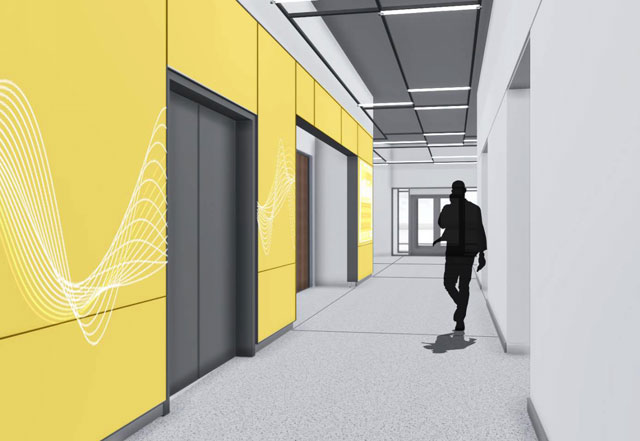
architectural rendering of lobby elevator area in Speech and Hearing Science Building

Also slated for completion this year is a $2.4 million renovation of the Speech and Hearing Science Building, built in the mid-1970s.

Originally conceived as a half-million dollar project to increase research space on the second floor, the College was able to expand the scope of the renovation through a campus initiative to repurpose underused facilities. Bill Goodman, former associate dean in AHS who is now a special assistant to Dean Cheryl Hanley-Maxwell, said the initial plan was to convert small rooms that had served as assessment rooms for the Speech-Language Pathology Clinic into usable space.

“The assessment rooms were rendered obsolete when the clinic moved to the Research Park area south of campus,” he said. “Our plan was to combine several of these smaller rooms into space that would be suitable for faculty research.”

The larger project will renovate more than 5,000 square feet on the second and first floors of the building, not only to provide for better research and teaching facilities but also to create a friendlier, more welcoming image for the Department of Speech and Hearing Science.

“You really had to hunt for the department’s administrative offices,” Mr. Goodman said. “The building didn’t have a very friendly or welcoming environment.”

The renovation project necessitated the disbursement of speech and hearing science faculty to alternative office space around campus. That’s been inconvenient, said SHS department head Karen Kirk, but the new facilities will make the temporary displacement worthwhile.

“The renovations will provide much-needed additional laboratory and student work space,” she said. “It also will give us enhanced meeting spaces of varying sizes that can be used for student seminars, research presentations, and large faculty meetings.”

Dr. Kirk also is excited about the relocation of administrative offices to the first floor, which will increase both the perceived and actual accessibility of SHS, and about the increased functionality and attractiveness of lobby areas on the first and second floors, which are used for student orientations, prospective student visits, and graduation receptions.

Also moved from the Speech and Hearing Science Building to allow for renovations was the University of Illinois Audiology Clinic, which now shares space with the Speech-Language Pathology Clinic in Research Park. That move is a permanent one, Dr. Kirk said, and will allow the department to provide integrated services to clients across the lifespan. And, she added, “Our clients are pleased with the free parking on site.”

Related news


Toy Talk promotes language development


Research shows that the more language-rich interactions children have with their parents, the faster they learn words and the better they understand them. Toys can help facilitate language-rich interactions.

The quantity and quality of interactions between parents and children are critical in early language development. Research has shown that the more language-rich interactions children have with their parents, the faster they learn words and the better they understand them. The quality of the interaction is also important, especially in terms of the responsiveness to children’s attempts to communicate.

Responsive Labeling, Self-talk, Parallel-talk

Language interventionists have typically relied upon three main language modeling strategies when working with parents to increase their responsiveness. The rest, responsive labeling, occurs when the parent labels an object that the child is playing with, saying, for example, “That’s a baby.” In self-talk, parents describe their own actions with the toy, for example, “I’m rocking the baby.” Parallel talk involves the parent describing the child’s actions with the toy, for example, “You’re feeding the baby.” Research has shown that these language modeling strategies lead to increases in the vocabulary used by toddlers and the length of sentences they produce. Dr. Pamela Hadley and Dr. Matthew Rispoli, associate professors in the Department of Speech and Hearing Science, were concerned that the language modeling strategies did not do enough to increase toddlers’ development of syntax, or the way words are combined to form sentences.

“These strategies—responsive labeling, self-talk, and parallel talk—actually reduce the diversity of the words in the input to the child, especially in the number of different words that appear as sentence subjects,” Dr. Hadley said. “They promote pronoun subjects such as it, that, you, and I to the exclusion of vast numbers of possible noun subjects.”

Toy Talk

Pam Hadley and Matt Rispoli

To increase the number of different words appearing as sentence subjects during interactions with children, Drs. Hadley and Rispoli designed a new language modeling strategy they call toy talk. The strategy shifts parent-child talk during play from the interpersonal space, or what the parent and child are doing, to descriptive talk about the toy itself, such as its location, properties, or actions in the play environment. Parents also are taught to give the object its name.

“Consider a child holding a bottle to a doll’s mouth,” Dr. Hadley said. “Instead of responding with ‘That’s a bottle,’ which is labeling, or ‘You’re feeding the baby,’ which is parallel talk, the parent could say, ‘The baby likes her juice’ or ‘The juice is gone.’ That’s toy talk.” Both toy talk sentences have noun subjects rather than pronouns, a subtle shift, she notes, but one that creates opportunities for parents to produce more diverse sentences.

It sounds simple but, perhaps surprisingly, toy talk sentences with nouns in the subject position are rare in naturally-occurring conversations between adults and young children, Dr. Rispoli noted. “It is much more common for adults to ask children questions—‘Are you feeding the baby?’—or to direct their behavior—‘Give the baby more juice’—or to make descriptive statements using pronoun subjects—‘It’s all gone,’” he said.

Toy Talk Benefits

The challenge of language acquisition has been described as putting words together. “But maybe the challenge is pulling words apart,” he said. “When children consistently hear phrases such as ‘It’s a doll,’ ‘That’s a horse,’ and so on, the subject and the verb get chunked together. The child may not understand that ‘itsa’ and ‘thatsa’ are actually three separate words.”

With funding from the National Institute of Child Health and Human Development, Drs. Hadley and Rispoli evaluated the effectiveness of toy talk in a study that taught parents of toddlers how to use toy talk in both group and individualized coaching sessions over a three-month period. Their study demonstrated that not only did parents’ use of toy talk sentences increase following the instruction but also that their use of toy talk predicted children’s rate of growth in the production of diverse simple sentences and other crucial elements of syntactic development over the following six months.

“We think toy talk works, in part, because the diversity of noun subjects in parents’ input makes it easier for children to identify the boundary between a subject and a verb,” Dr. Hadley said. She and Dr. Rispoli emphasized that toy talk is not a replacement for other language modeling strategies. “Rather, it should be integrated with other strategies to interpret and expand children’s communication attempts and to model diverse combinations of words within simple sentence structure,” she said.

Because toy talk represents a relatively minor modification of familiar language modeling strategies, both scholars believe it can be incorporated rapidly into existing clinical practice.

Related news

Department of Speech and Hearing Science
901 South Sixth Street
M/C 482
Champaign, IL 61820
217-333-2230