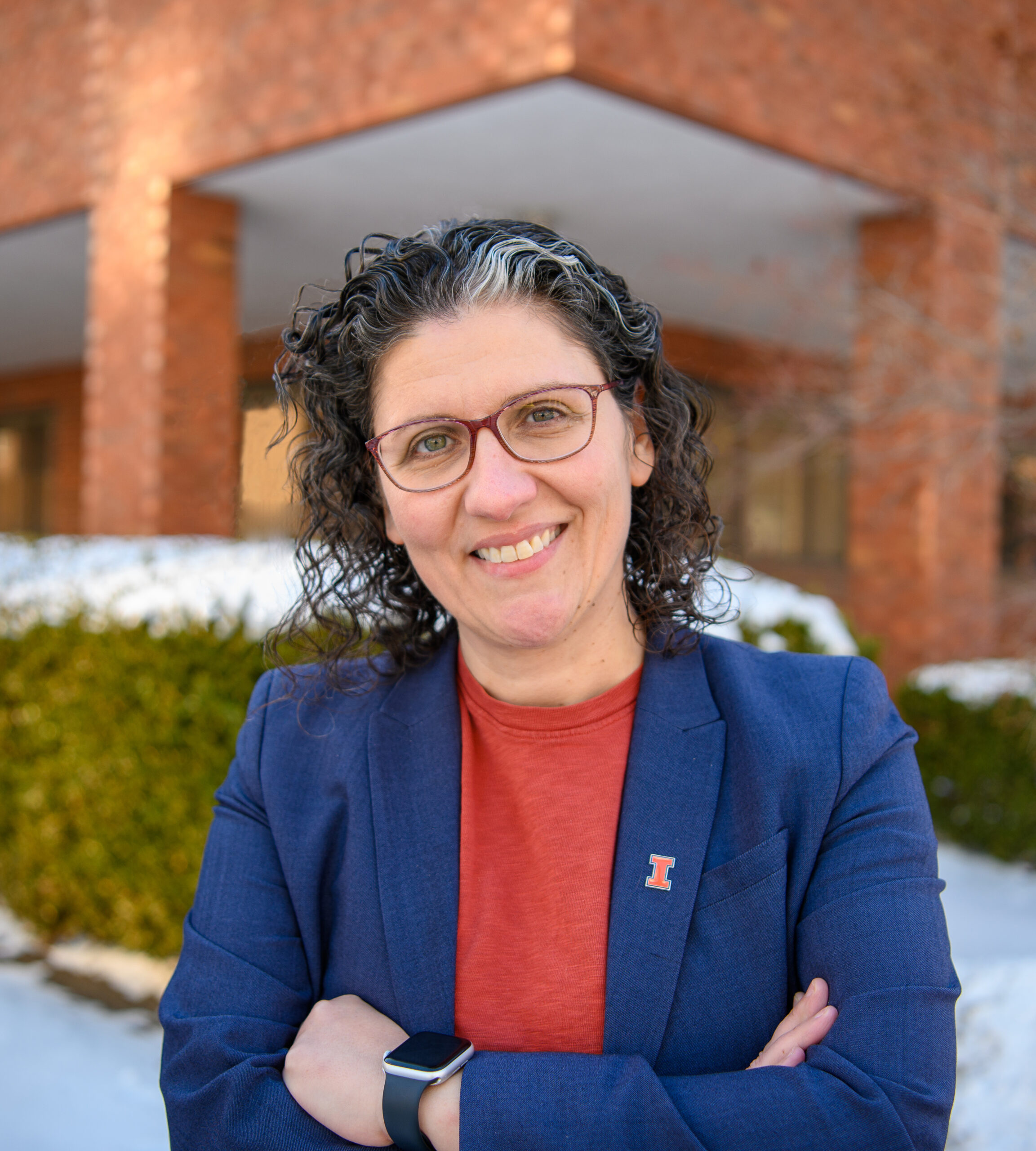
“I welcome perspectives from everyone (…) because the future we create together will be stronger for it.“
Georgia Malandraki, professor and department head of Speech and Hearing Science, has begun her second month as department head. (Ethan Simmons/College of AHS)
Dear Speech and Hearing Science community,
It is with pride and a deep sense of responsibility that I begin my role as Head of the Department of Speech and Hearing Science. Returning to Illinois, where I completed my Ph.D. and where many of our distinguished faculty shaped my early career, feels like coming home. It is both humbling and exciting to now have the opportunity to give back to the community that supported me from the start.
Over the past several months, I have begun to learn the many stories, strengths, and aspirations that make SHS such a vibrant community. Every conversation with faculty, staff, and students has reminded me of something I have known since I was a student here: SHS is a community where excellence and compassion go hand in hand, and where people genuinely care about making an impact. I am grateful to join you as we continue building on that foundation together.
I am thankful to be joining the department at a time of remarkable momentum, built under the leadership of former Head and Professor Pamela Hadley and Dean Cheryl Hanley Maxwell. The shared governance model, the selfless and dedicated service of faculty, the collective passion for impactful research and clinical training, and the strong commitment to inclusion that I have witnessed during this transition are outstanding.
Equally impressive is the work ethic and dedication of our faculty, staff, and students, clear indicators of the remarkable potential ahead. Importantly, the support and enriching environment provided by the College of Applied Health Sciences and the University as a whole foster collaboration, innovation, and sustained excellence, creating the conditions for SHS to grow and continue its legacy as one of the leading departments in the state and the country.
As we look toward the future, I see a department that not only sustains this legacy but continues to grow its reach locally, nationally, and globally. Together, we will focus on our shared goals:
Strengthening our position as a global leader in research and clinical training in communication sciences and disorders
Empowering students through exceptional and forward-thinking education
Expanding our engagement with communities and partners who rely on our expertise
Growing the resources and support needed to enhance discovery, education, and service
These are meaningful goals, and I am confident we can achieve them. The talent, commitment, and heart I see within SHS are truly remarkable.
In the coming months, I look forward to hearing your ideas, learning from your experiences, and working with you to shape the next chapter of SHS. I welcome perspectives from everyone—students, alumni, faculty, staff and friends—because the future we create together will be stronger for it.
Thank you for the very warm welcome. I am inspired by this department, energized by its potential, and honored to walk forward with you.
With warmest regards, Georgia A. Malandraki, Ph.D., CCC-SLP, BCS-S, ASHA Fellow Professor and Head
More than 2 million people live with aphasia in the U.S.
Bruce Willis’ aphasia diagnosis went public in April 2022.
Aphasia is a communication disorder that affects understanding and expression. It can make it difficult to speak, write, listen, and read. But despite its dire impact on people, aphasia is not a well-known condition. In fact, according to a 2016 survey by the National Aphasia Association (NAA), less than 10 percent of respondents knew what aphasia was.
But the announcement in April 2022 that Bruce Willis would be stepping away from acting following an aphasia diagnosis has raised awareness of the affliction, said Abby Franz, a speech pathologist and clinical instructor in the Department of Speech & Hearing Science at University of Illinois.
“I feel awful for the family and his situation and that he has that diagnosis,” Franz said. “But in 2016, the NAA conducted a survey and found only 8.8 percent of the respondents knew what aphasia was and correctly identified it as a language disorder. So certainly Bruce Wilson’s diagnosis can bring awareness to aphasia. But it’s common. More than two million people are living with aphasia in the United States, and for only 8 percent of the general population to know what it is and know that it was a language disorder, that’s pretty significant.”
Aphasia is an acquired communication disorder, Franz said, which means that it’s something that happens during the course of a life. It’s not something that is present from birth. It is an acquired neurogenic communication disorder, usually as a result of a stroke or some type of brain injury, she said.
There are many types of aphasia, and they are usually diagnosed based on which area of the language-dominant side of the brain is affected and the extent of the damage.
“Typically, it is something traumatic like a type of traumatic brain injury, either they’ve fallen, they’ve hit their head, they’ve been in a car accident, which has affected the area of the brain that controls our speech and language, or a sudden stroke that has left them with difficulty with speech and language,” Franz said.
“But there is another type of aphasia called primary progressive aphasia. That is a degenerative disease that is caused by a type of dementia—frontotemporal lobe dementia. It isn’t a sudden onset change in language. It’s a gradual deterioration of brain tissue in the frontal lobe of our brain that causes, over time, kind of your language to really deteriorate and comprehension of language to deteriorate.”
Franz did not want to speculate about whether Willis has primary progressive aphasia (PPA), but said what she read about his diagnosis lead her to believe he is afflicted with PPA.
“When you have a stroke, it just happens, like suddenly onset. So there wouldn’t be this gradual deterioration” of what has been speculated to have happened to Willis, she said.
Primary progressive aphasia symptoms are akin to dementia. Franz said, with primary progressive aphasia, there would be difficulty with word finding, difficulty sometimes with even just the production of speech, or more effortful for them to even just formulate a sound. They may have a loss in just the fluency of speech as well as the comprehension of speech.
“Somebody who has primary progressive aphasia, if I showed him (a pen), he or she may not be able to name it, but then they also may not even be able to tell me what it does. So they lose that ability to even know this is a pen and we write with it,” she said.
As a speech language pathologist, Franz said she makes aphasia determinations based on how patients perform on certain tasks during a language assessment.
“We’re also testing their comprehension of language. We’re looking at their ability to follow simple directions, follow two-step directions. And we’re looking also at their ability to write after a stroke or after a brain injury because sometimes those go hand-in-hand with the loss of language.”
That said, an aphasia diagnosis is not always without hope. With the help of rehabilitation intervention provided by a speech-language pathologist, people with aphasia from a stroke or other brain injury can improve. SLPs partner with people with aphasia and their families to improve communication skills and develop strategies to support their communication strengths, and may assist with using an augmentative and alternative communication speech devices for those individuals if needed.
However, Franz speculates that because Willis’ family said the actor would pull back from public appearances, she believes he has primary progressive aphasia, and that the prognosis for that is not promising. According to the NAA, the average life expectancy from onset of the disease is 8 to 10 years.
“It is that dire when you get that diagnosis,” Franz said. “It’s a very slow progression of the loss of their communication and along with this kind of dementia too that goes along with it.”
Talking about PPA is “very personal” to Franz.
“My parents’ best friend was diagnosed with primary progressive aphasia in 2017,” she said. “And he’s still living. I see the professional side of it. But now I’m living it on a personal note. And it’s been very hard.
“When he got the diagnosis, I had to do a lot of education with my family about it, especially my parents. Because this was their best friend, and he’s been a part of my life since I was born. And you know, I had to educate them a lot about what primary progressive aphasia is and what it’s going to look like at the end of life. So that is not a great diagnosis to have. So I understand, for the family, why they are probably wanting to shield Bruce Willis from being in the public eye.”
When a public figure such as Willis is afflicted, it often brings an opportunity to educate people about a disease or medical condition.
“The National Aphasia Association is a great website and a great reference for anybody to learn more about aphasia or just to understand more about what it is, and find support groups, within your local community,” Franz said. “It’s a great reference and website to look for if you have a family member or know somebody who has been given the diagnosis of aphasia.”
Project aims to compare fetal auditory exposures in the womb and in the neonatal intensive care unit
Brian Monson in his office (Credit: Brian L. Stauffer)
A researcher in the Department of Speech and Hearing Science in the College of Applied Health Sciences has received funding to determine the difference in language exposures for preterm infants relative to what they would be hearing if they were still in the womb.
SHS assistant professor Brian Monson earned a $300,000 grant from the National Institute of Deafness and Communication Disorders for his project entitled, “Auditory experience during the prenatal and perinatal period.”
Monson said the aims of the project include comparing typical fetal auditory exposures in the womb to preterm infant auditory exposures in the neonatal intensive care unit, and assessing the effect of these exposures on auditory neurodevelopment. The study, he said, is being conducted in collaboration with Carle Hospital, with the long-term goal of optimizing auditory exposures for preterm infants to foster healthy brain development in the neonatal intensive care unit.
“We also hope to see whether these differences in exposures have an effect on later brain and language development,” Monson said.
The grant from the NIDCD—which is part of the National Institutes of Health—helps extend upon research Monson undertook with funding from a Center for Health, Aging & Disability (CHAD) pilot grant.
Monson said the plan is to enroll 100 preterm infants and 100 pregnant women who carry to full term, with recruiting done locally of pregnant women from the Champaign-Urbana community and NICU patients from Carle Hospital. He said data collection had begun and that he had about 30 subjects in each group.
Once differences between exposures in the NICU vs. the womb are established, Monson said, the next step would be to develop an intervention that enhances NICU auditory exposures (e.g., by increasing language exposure) and assess the effects of this intervention with a clinical trial. “We also plan to continue following up with the current study’s babies later in childhood,” he said.
“One out of every 10 babies born in Illinois is born premature, which is similar to the national rate,” Monson said. “Because of this, we feel this project is critically important as it will lead to improved health outcomes for our community’s tiniest human beings.”