SHS researchers patent method to extract speech from noise using high frequencies


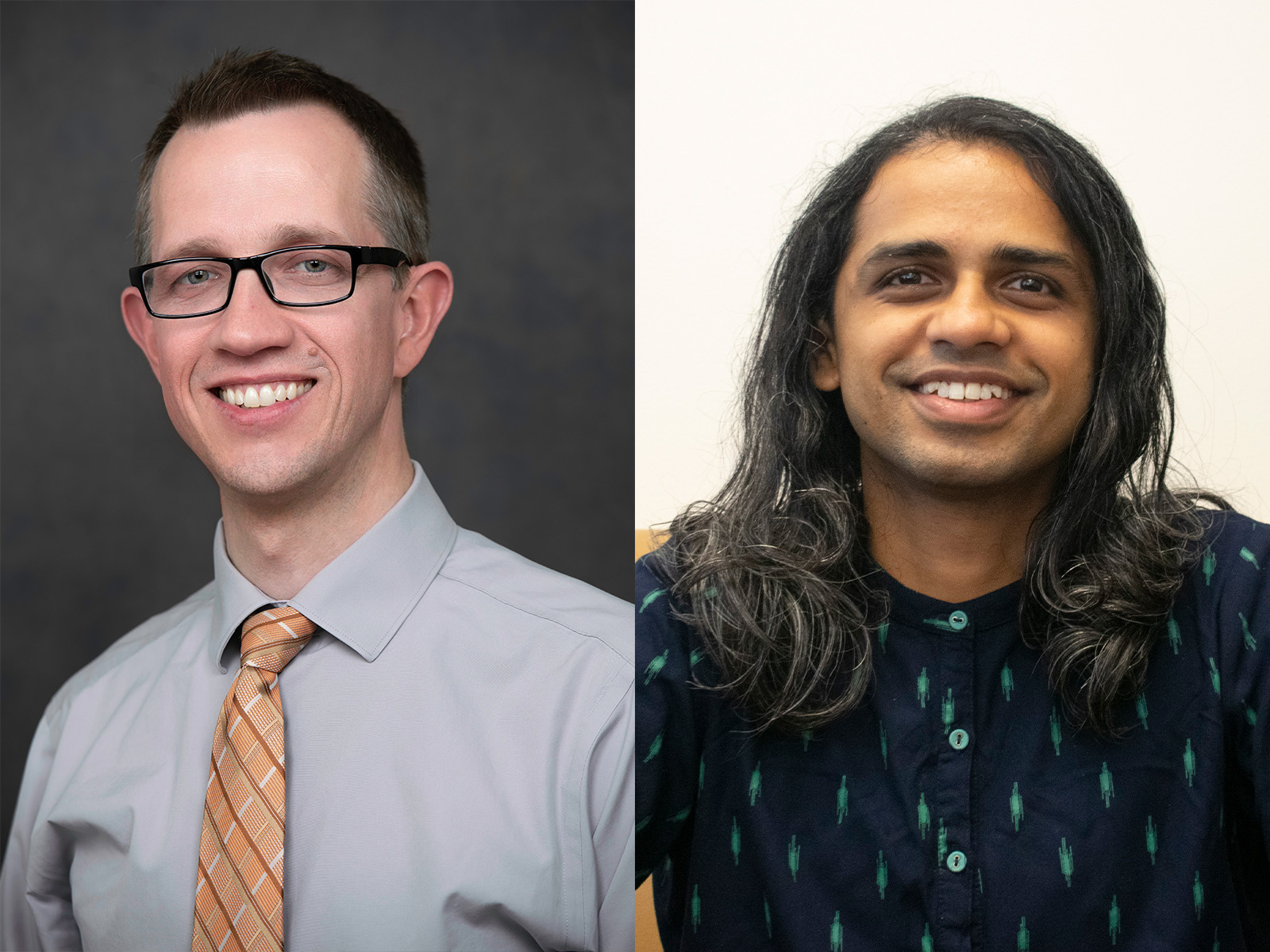
Associate Professor Brian Monson and Speech and Hearing Science Ph.D. student Rohit Ananthanarayana.

When we speak, the air moving through our vocal cords generates soundwaves vibrating at different frequencies: the higher the frequency, the higher the pitch. 

Most of our modern audio technology, including hearing aids, headphones, and phone conversations chop off the “top end” of these soundwaves to compress the information coming in while keeping speech understandable. 

But these extended high frequencies—8,000 Hz and above—contain important signals in the human voice, especially for comprehending speech in noisy environments. 

Two researchers in the Department of Speech and Hearing Science at the University of Illinois Urbana-Champaign, Associate Professor Brian Monson and doctoral student Rohit Ananthanarayana, have patented an algorithm to identify and extract speech signals from noise by using extended high-frequency information. 

The technique is novel, and with some investment, could be mapped onto existing modern hearing aids, earbuds and more. 

Where are these high frequencies useful? Picture a restaurant date where you’re trying to pay attention to your partner speaking on the other end of the table, and voices of other customers are bouncing all around you. 

“In those noisy settings in particular, that’s when these higher frequencies become valuable,” Monson said. “All the background noise masks out and interferes with those low frequencies, whereas these really high frequencies tend to stay pretty stable and unmasked, undegraded by the background noise.” 

Humans can hear frequencies vibrating from 20 Hz all the way up to 20,000 Hz. Most modern hearing aids capture frequencies up to 6,000 Hz, which covers most everyday sounds. Most clinical hearing tests don’t test subjects’ hearing above this range. 

Consonant sounds called “voiceless fricatives,” such as “s,” “sh,” “f” and “ph” sounds, contain energy above 8,000 Hz. Through grant-funded experiments, the researchers have shown the usefulness of these high-end frequencies—such as determining whether someone is facing you and speaking, or if they’re facing a different direction. 

In those noisy settings in particular, that’s when these higher frequencies become valuable.

Brian Monson

Associate Professor, Department of Speech and Hearing Science at Illinois

One experiment conducted by Monson and Ananthanarayana asked participants to listen to another person speaking, with and without the high-frequency range, and determine whether the speech was directed at them or not. 

“If you test listeners’ ability to perform this task, to determine whether someone’s looking at you or looking away, they do quite a bit better at that task if they have access to those really high frequencies,” Monson said.

While performing high-frequency research, the algorithm became an interesting side project to work on. The algorithm was developed to be retrofitted as well: the listening benefits could be implemented on existing tech with a firmware update. 

“We wanted to find some way to utilize the information in those extended high frequencies to enhance the target speech signal,” said Ananthanarayana, who began his Ph.D. at Illinois in 2021. “We identified a way that was novel but also feasible to try out with the resources and time that we had.” 

The patent itself was four years in the making; Monson filed the provisional patent in December 2021, and the two researchers used their backgrounds in electrical engineering to test, code and strengthen the algorithm further. 

To test its efficacy, they ran the algorithm on simulated speech recordings, where the “target talker” uttered short sentences in a noisy environment. The algorithm was judged for its ability to enhance the target signal’s clarity while suppressing background noise. 

Together with the Office of Technology Management, Ananthanarayana and Monson put together their patent application to safeguard their idea, which was awarded in October. 

“Ideally, someone would take interest in this—whether that’s us or someone else—and run with it to see if it’s implementable in hearing aid technology or other assistive listening device tech, like over-the-counter hearing aids, earbuds, headphones,” Monson said. “We think there’s potential there.”

Editor’s note:

The patent “Speech Identification and Extraction from Noise Using Extended High Frequency Information” was approved in October 2025. 

To reach Brian Monson, email monson@illinois.edu 
To reach Rohit Ananthanarayana, email rohitma2@illinois.edu

 

Related news

SHS Fall 2023 Promotions and Tenure


Raksha Mudar

Raksha Mudar, who joined the faculty of the Department of Speech and Hearing Science in 2011, was promoted to full professor in 2023. Mudar, who earned her Ph.D. from the University of Texas at Dallas, is the director of the Aging and Neurocognition Lab. 

Mudar investigates the effects of normal cognitive aging and brain diseases including mild cognitive impairment, Alzheimer’s disease and frontotemporal dementia on higher order semantic functions. She uses a combination of behavioral methods, event-related potentials and functional magnetic resonance imaging in her research.

“I am deeply honored to be promoted to full professor at such an esteemed institution of higher education and research,” Mudar said. “My path to full has been very rewarding. I chose academia because both research and teaching bring so much joy to me. Looking back, I know I chose right, and am excited for what lies ahead.”

Mudar was elected as a fellow of the American Speech-Language-Hearing Association at the ASHA Convention 2022—one of the highest forms of recognition given by ASHA. Mudar has been involved in several federally funded grants and is currently the primary investigator on an R01 titled “Digital Technology to Support Adherence to Hypertension Medications for Older Adults with Mild Cognitive Impairment.”

Brian Monson

Brian Monson, who joined the faculty of the Department of Speech and Hearing Science in 2017, was promoted to associate professor in 2023. Monson, who received his Ph.D. from the University of Arizona, is the director of the Auditory Neuro Experience Lab. His field of research is in auditory neuroscience. 

Monson holds degrees in electrical engineering, acoustics and speech/language/hearing science, with further specialization in neuroscience and music. With this background, he takes an interdisciplinary approach to auditory research, interfacing with clinicians, scientists, engineers and musicians. His research interests center around auditory neurodevelopment and speech/voice perception.

Monson is the principal investigator on an R01 grant from NIH-NIDCD for his project titled, “The ecological significance of extended high-frequency hearing in humans,” and the PI on an R21 from the NIH-NIDCD as well as the co-PI on another R21.

“I’m quite honored to become a tenured faculty member at such a reputable institution as the University of Illinois,” Monson said. “I very much look forward to continuing to serve our students and our community with my colleagues in Speech and Hearing Science and in Applied Health Sciences.”

Pasquale Bottalico

Pasquale Bottalico, who joined the faculty of the Department of Speech and Hearing Science in 2017, was promoted to associate professor in 2023. Bottalico earned his bachelor’s degree in telecommunications engineering from Univeristà Mediterranea di Reggio Calabria (Italy), while simultaneously pursuing a degree in opera singing at the F. Cilea Music Academy of Reggio Calabria (Italy). 

In 2005, he moved to Turin where he earned his master’s degree in telecommunications engineering from Politecnico di Torino (Italy). Bottalico earned his Ph.D. in metrology, studying acoustics with particular attention to the uncertainty of measurements and statistical analysis of data. Bottalico is particularly interested in the professional voice user and singer techniques, as well as the definition and the quantification of vocal load. Other fields he is interested in are speech intelligibility, room acoustics and musical acoustics.

Bottalico is also a professional chorister, having performed under such prestigious directors as Rafael Frühbeck De Burgos, Yuri Ahronovitch, Jeffrey Tate, Juanio Mena, Gianandrea Noseda, Ottavio Dantone, Wayne Marshall, Helmuth Rilling, Christopher Hogwood, Robert King and Ivor Bolton.

“Attaining tenure and rising to the role of associate professor is a profound validation of my dedication to enlightening minds, pushing the boundaries of knowledge and contributing to the ever-evolving academic landscape,” Bottalico said. “It signifies not just personal achievement but the faith others place in my ability to continually inspire students and illuminate the paths of intellectual exploration.”

Related news

CHAD symposium returns with thanks for pilot grants


KCH Associate Professor Naiman Khan’s presentation was titled “Role of Omega-3 Lipid Metabolites in Obesity and Cognitive Function” (Photo by Lisa Bralts)

The first Center for Health, Aging, and Disability (CHAD) symposium since 2017 was a celebration of the research accomplished with the help of the Pilot Grant Program.

Three researchers from the College of Applied Health Sciences—Naiman Khan, an associate professor in Kinesiology and Community Health; Brian Monson, an assistant professor in Speech and Hearing Science, and Sharon Zou, an assistant professor in Recreation, Sport and Tourism, made a point of thanking CHAD’s grants for helping launch their studies.

Khan, whose presentation was titled “Role of Omega-3 Lipid Metabolites in Obesity and Cognitive Function,” said CHAD’s funding was vital to his work.

“CHAD was really helpful in us starting a new line of engagement of research,” he said. 

CHAD director Jeff Woods, AHS’ associate dean for research, said to date, 38 pilot grants have been awarded since CHAD was launched in 2010, with $860,000 awarded to AHS researchers for pilot research. Woods described CHAD’s role as “work at the bookends of medicine … with the goal of improving people’s lives.”

“CHAD pilot grants are really important for junior faculty,” Zou said.

And the payoff has been well worth it, Woods said, citing the return on investment as approximately $16 in external funding to $1 in CHAD funding. 

Zou’s presentation was titled “Exploring an Efficient and Equitable Entrance Fee for Public Lands: A Community-based investigation in the Indiana Dunes National Park.”

“I study how people have fun,” Zou said, explaining that it was vital for public parks and other tourism industries to build a sustainable revenue model and not to rely on decreasing funding from state and federal sources. 

The primary purpose of Zou’s study was to “understand visitors’ and surrounding community residents’ perceptions of Indiana Dunes National Park user fees to inform a fee structure that balances revenue generation and equitable access.”

During and after the COVID-19 pandemic, Zou said, “parks saw explosions of people visiting.” While that was great for parks in terms of revenue, it also led to increasing operation costs at a time when government funding for these sites is being reduced.

“The specific goal is to find out how visitors see the park fees, and are they fair?,” Zou said.

The RST researcher said her preliminary findings indicate there was no consensus from study participants on what “fair” means, and that tension between fairness principles partly explains the longstanding controversy and debate on public land user fees.

Khan’s presentation focused on how poor lifestyle choices can predict an early onset of dementia, noting that obesity worldwide has increased threefold since the 1980s. The KCH researcher said his research, in conjunction with Aditi Das of Georgia Tech, suggested that the a deficiencyin the hormone dehydroepiandrosterone (DHEA)—which has been reported to have beneficial effects on obesity, diabetes mellitus, and serum lipids in animals—was associated with individuals with a body-mass index (BMI) of 25 or higher, which is classified as obese.

“BMI is inversely connected to cognitive function,” Khan said. “Only in obese individuals do we see DHEA increase in circulation.” Khan said his preliminary results found:

  • Circulating Omega-3 metabolites were higher among persons with higher weight status and the levels were associated with degree of fat mass
  • Circulating metabolites inversely associated with cognitive function
  • Only observed among persons with overweight and obesity
  • Selectively associated with hippocampal function
  • Implications for memory function

Khan said his overarching goal was to “develop effective lifestyle approaches to improve cognitive function.”

SHS’ Monson discussed his study called “Capturing Prenatal Auditory Experience.”

“If there was a pregnant woman in this audience, that baby would be hearing my voice, and perhaps making judgments,” he said, drawing laughter from the gathering. “How do we know? Because full-term newborns come to the world with memories of what they’ve heard, including the mother’s voice.”

In utero, Monson explained, was a unique acoustic environment. When preterm infants are delivered, they are placed into incubators, which rapidly changed the sound profile, he said. The consequences of those changes include increased risk for sensorineural hearing loss, auditory neuropathy, language and speech developmental delays, auditory attention deficits and auditory processing disorder.

Monson’s study involved a group of pregnant women wearing a LENA listening device twice a week during the third trimester, while the device was placed into cribs of very preterm infants at Carle Foundation Hospital three times a week through their stay in a neonatal intensive care unit (NICU).

“Fetuses are getting 2.5 hours a day of speech exposure vs. 32 minutes a day for very preterm infants,” he said. “It’s an alarming difference to me.”
NICU infants may incur a deficit of about 150 hours of speech exposure over the course of the preterm period, he explained.

One of the possible mitigation strategies for very preterm infants could be to provide meaningful targets (about three hours a day of speech exposure) to optimize auditory exposures in NICU settings.

“The maternal heartbeat is never turned off in utero,” he said. “The maternal heartbeat is never turned on in NICU.”

Following the CHAD Pilot Grant success stories, Wendy Rogers, the Shahid and Ann Carlson Khan Professor of Applied Health Sciences, talked about the work of Collaborations in Health, Aging, Research, & Technology (CHART).

CHART’s mission is to enable successful aging through:

  • Fundamental research
  • Advanced technology development
  • Education of researchers, developers, healthcare professionals, older adults
  • Guidance for policy decision-making
  • Translation of these efforts to positively affect the lives of older adults

CHART was the first research theme of the College of Applied Health Sciences and boasts the development of the McKechnie Family LIFE Home, an interdisciplinary research facility and simulated home environment that helps promote community engagement, industry partnerships, healthcare collaborations and faculty innovation.

Also part of the symposium was the introduction of a new AHS research theme called CARD (Collaborations in the Advancement of Research on Disability), led by KCH Associate Professor Laura Rice and KCH Professor John Kosciulek. CARD is focused on enhancing the health and quality of life of people with disabilities—through research that addresses critical gaps in disability-related knowledge and outreach that engages individuals with disabilities. 

CARD’s short-term goals include:

  • Develop a collaborative working group
  • Develop communication strategies
  • Establish a steering committee of stakeholders
  • Develop and implement outreach and engagement events

Longer-term goals include:

  • Host a bi-annual research symposium
  • Develop a “toolkit” for UIUC faculty to support the performance of disability-related research in the Champaign-Urbana area
  • Respond to disability-related funding opportunities
  • Establish a competitive program to provide supplemental funding to support ongoing disability research among junior faculty
  • Host a seminar series with external experts
  • Establish a research training program for students registered with DRES interested in doing research
  • Support the development of new research registries and/or expansion of current registries

The first CARD meeting is set for March 22.

In kicking off the symposium, AHS Dean Cheryl Hanley-Maxwell said CHAD was “one of the biggest attractions” of her decision to come to Illinois and lead the college.

“When I thought about CHAD, I thought it’d be interesting to lead a college that has this kind of momentum to it, and I’ve been proven correct, year after year,” she said. “CHAD provides students with real-world engagement, and plays an absolutely critical role in their professional development.”

Woods agreed.

“We’re helping put the next generation of scientists into the field.”

Editor’s note:

To reach Vince Lara-Cinisomo, email vinlara@illinois.edu.
 

Related news

Exploring Extended High-Frequency Hearing


Brian Monson (Photo by Brian L. Stauffer)

Can you imagine having a conversation that included none of the following consonant sounds: s, sh, f, and ph? Known as voiceless fricatives, much of their energy occurs at the range of human hearing above 8 kilohertz (kHz), called extended high frequencies. In general, consonants tend to have more energy at the extended high frequencies than vowels. Yet conventional clinical hearing tests do not assess the performance of the auditory system above 8 kHz—which is above the highest notes on a piano—because of a longstanding assumption that hearing above 8 kHz is not important.

As Speech and Hearing Science Assistant Professor Brian Monson explains, the assumption took root during the development of the telephone about 100 years ago, when speech signals had to be compressed for transmission across wires. Early researchers simply cut out certain frequencies and asked people if they could still understand what was being said.

“Basically, they found that you didn’t need to hear frequencies above 3 or 4 kHz to have really good intelligibility,” he said, “and that got interpreted as ‘energy at higher frequencies is not important for speech.’”

For more than 10 years, Dr. Monson has been intrigued by and trying to answer the question, “If hearing above 8 kHz is not important, why is the human auditory system capable of hearing up to 20 kHz?” He recently received a five-year, $2 million grant from the National Institute on Deafness and Other Communication Disorders to continue his work in this area with a study titled “The ecological significance of extended high-frequency hearing in humans,” a study on which he will collaborate with researchers at the University of North Carolina and Boys Town National Research Hospital.

Extended high frequencies and noise

In this area of research, Dr. Monson’s basic hypothesis is that not only does extended high-frequency hearing have utility for humans, it plays a role in speech perception. His research group was one of the first to examine the value of extended high frequencies in the speech signal, and the first to demonstrate that extended high frequencies help listeners to determine whether speakers are facing them or turned away from them.

His research has scientific implications, of course, and expanding the state of knowledge in speech and hearing science means a great deal to Dr. Monson. There also is the potential for practical applications of his findings as well, for audiology testing, diagnosis, and intervention.

First of all, only testing below 8 kHz in the clinic does not measure the true function of the auditory system. Extended high-frequency hearing loss is the most common loss in humans because it occurs naturally with aging, with substantial loss occurring even by middle age. So if extended high frequencies are found to play a significant role in speech comprehension, everyone eventually will be affected and everyone will have undiagnosed, or hidden, hearing losses which are not detected by standard audiograms. To date, Dr. Monson and his colleagues have found a modest relationship between extended high frequencies and speech comprehension, but, importantly, it is in noisy environments that extended high frequencies are the most valuable.

“The number one complaint of hearing aid users, for many years, has been that they still have a hard time understanding speech in noisy situations,” Dr. Monson said. “Hearing aids do not represent extended high frequencies.”

Is the impact on speech comprehension large enough to justify taking on the challenge of developing new hearing aid technologies that restore extended high-frequency hearing? That is one of the questions that he hopes to address in the newly funded study. It will expand on a study published in 2019 that simulated a cocktail party but used only two background talkers. The new study will create an even more realistic noisy environment by using multiple talkers in different locations around a listener, as well as realistic reverberations that recreate how sound bounces around different room settings. It also will include a localization experiment to investigate whether extended high frequencies help listeners to determine where the talker of interest is located, with the assumption that this ultimately helps listeners to tune out other talkers.

While he would like his research to result in effective restorative technologies for individuals with extended high frequency hearing loss, Dr. Monson is excited that it already provides compelling evidence for assessing extended high-frequency hearing in the audiology clinic. In a 2020 paper in Hearing Research, he and others argued that implementation of extended high-frequency audiometry into clinical practice is relatively easy. Furthermore, measurements of hearing loss at extended high frequencies do predict speech perception ability in noise, suggesting such measures could be useful in identifying individuals at risk for listening difficulties in noisy situations. As he continues his research in this area, he hopes that continuing to present his findings through journals and conferences that target audiologists will positively impact clinical practice.

Related news

Grant to help researcher study difference in hearing for preterm babies


Brian Monson in his office (Credit: Brian L. Stauffer)

A researcher in the Department of Speech and Hearing Science in the College of Applied Health Sciences has received funding to determine the difference in language exposures for preterm infants relative to what they would be hearing if they were still in the womb. 

SHS assistant professor Brian Monson earned a $300,000 grant from the National Institute of Deafness and Communication Disorders for his project entitled, “Auditory experience during the prenatal and perinatal period.”

Monson said the aims of the project include comparing typical fetal auditory exposures in the womb to preterm infant auditory exposures in the neonatal intensive care unit, and assessing the effect of these exposures on auditory neurodevelopment. The study, he said, is being conducted in collaboration with Carle Hospital, with the long-term goal of optimizing auditory exposures for preterm infants to foster healthy brain development in the neonatal intensive care unit.

“We also hope to see whether these differences in exposures have an effect on later brain and language development,” Monson said.

The grant from the NIDCD—which is part of the National Institutes of Health—helps extend upon research Monson undertook with funding from a Center for Health, Aging & Disability (CHAD) pilot grant.

Monson said the plan is to enroll 100 preterm infants and 100 pregnant women who carry to full term, with recruiting done locally of pregnant women from the Champaign-Urbana community and NICU patients from Carle Hospital. He said data collection had begun and that he had about 30 subjects in each group.

Once differences between exposures in the NICU vs. the womb are established, Monson said, the next step would be to develop an intervention that enhances NICU auditory exposures (e.g., by increasing language exposure) and assess the effects of this intervention with a clinical trial.  “We also plan to continue following up with the current study’s babies later in childhood,” he said.

“One out of every 10 babies born in Illinois is born premature, which is similar to the national rate,” Monson said. “Because of this, we feel this project is critically important as it will lead to improved health outcomes for our community’s tiniest human beings.”

Editor’s note:

To reach Brian Monson, email monson@illinois.edu.
 

Related news

Department of Speech and Hearing Science
901 South Sixth Street
M/C 482
Champaign, IL 61820
217-333-2230