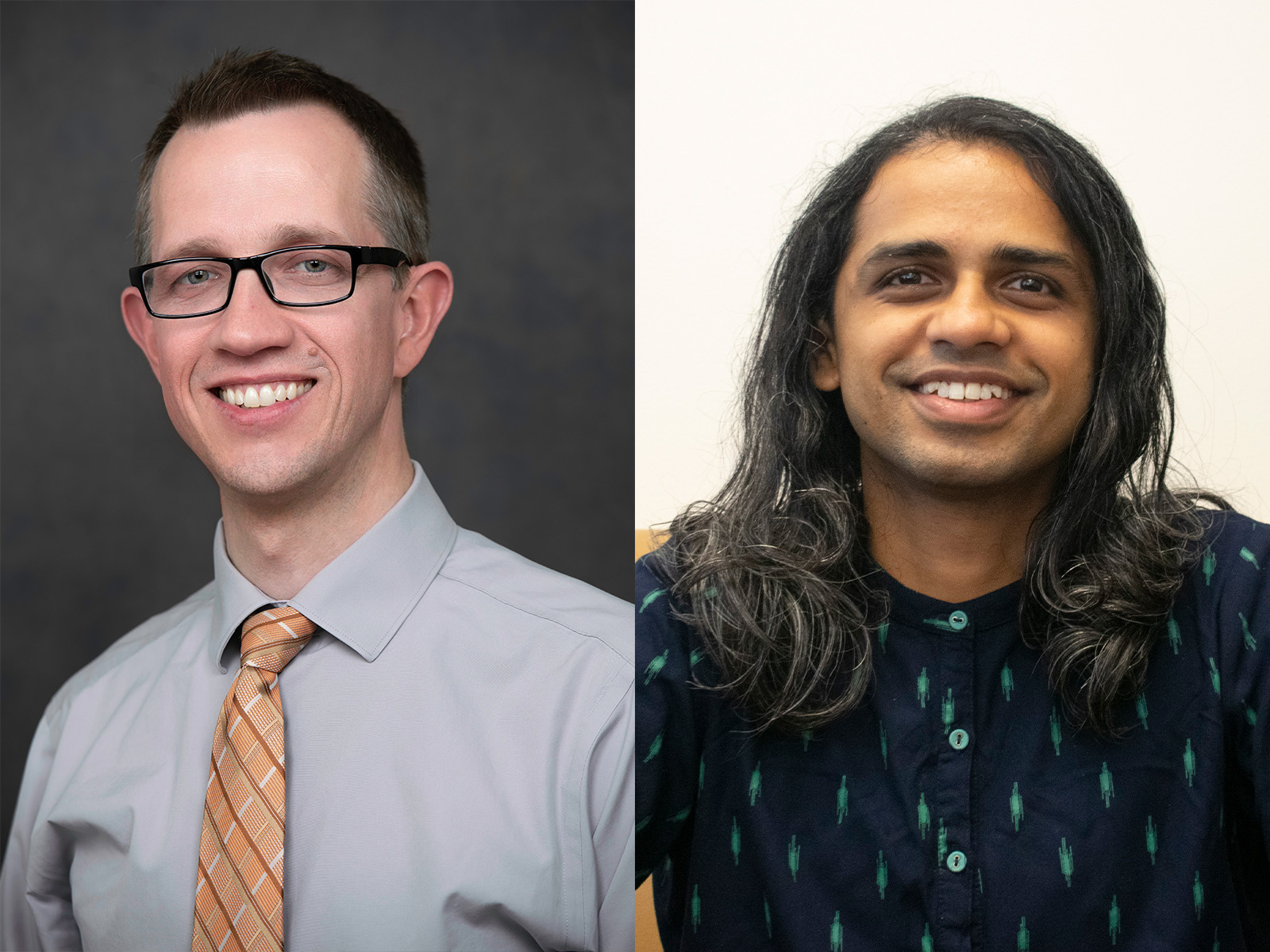
SHS researchers patent method to extract speech from noise using high frequencies


Associate Professor Brian Monson and Speech and Hearing Science Ph.D. student Rohit Ananthanarayana.

When we speak, the air moving through our vocal cords generates soundwaves vibrating at different frequencies: the higher the frequency, the higher the pitch. 

Most of our modern audio technology, including hearing aids, headphones, and phone conversations chop off the “top end” of these soundwaves to compress the information coming in while keeping speech understandable. 

But these extended high frequencies—8,000 Hz and above—contain important signals in the human voice, especially for comprehending speech in noisy environments. 

Two researchers in the Department of Speech and Hearing Science at the University of Illinois Urbana-Champaign, Associate Professor Brian Monson and doctoral student Rohit Ananthanarayana, have patented an algorithm to identify and extract speech signals from noise by using extended high-frequency information. 

The technique is novel, and with some investment, could be mapped onto existing modern hearing aids, earbuds and more. 

Where are these high frequencies useful? Picture a restaurant date where you’re trying to pay attention to your partner speaking on the other end of the table, and voices of other customers are bouncing all around you. 

“In those noisy settings in particular, that’s when these higher frequencies become valuable,” Monson said. “All the background noise masks out and interferes with those low frequencies, whereas these really high frequencies tend to stay pretty stable and unmasked, undegraded by the background noise.” 

Humans can hear frequencies vibrating from 20 Hz all the way up to 20,000 Hz. Most modern hearing aids capture frequencies up to 6,000 Hz, which covers most everyday sounds. Most clinical hearing tests don’t test subjects’ hearing above this range. 

Consonant sounds called “voiceless fricatives,” such as “s,” “sh,” “f” and “ph” sounds, contain energy above 8,000 Hz. Through grant-funded experiments, the researchers have shown the usefulness of these high-end frequencies—such as determining whether someone is facing you and speaking, or if they’re facing a different direction. 

In those noisy settings in particular, that’s when these higher frequencies become valuable.

Brian Monson

Associate Professor, Department of Speech and Hearing Science at Illinois

One experiment conducted by Monson and Ananthanarayana asked participants to listen to another person speaking, with and without the high-frequency range, and determine whether the speech was directed at them or not. 

“If you test listeners’ ability to perform this task, to determine whether someone’s looking at you or looking away, they do quite a bit better at that task if they have access to those really high frequencies,” Monson said.

While performing high-frequency research, the algorithm became an interesting side project to work on. The algorithm was developed to be retrofitted as well: the listening benefits could be implemented on existing tech with a firmware update. 

“We wanted to find some way to utilize the information in those extended high frequencies to enhance the target speech signal,” said Ananthanarayana, who began his Ph.D. at Illinois in 2021. “We identified a way that was novel but also feasible to try out with the resources and time that we had.” 

The patent itself was four years in the making; Monson filed the provisional patent in December 2021, and the two researchers used their backgrounds in electrical engineering to test, code and strengthen the algorithm further. 

To test its efficacy, they ran the algorithm on simulated speech recordings, where the “target talker” uttered short sentences in a noisy environment. The algorithm was judged for its ability to enhance the target signal’s clarity while suppressing background noise. 

Together with the Office of Technology Management, Ananthanarayana and Monson put together their patent application to safeguard their idea, which was awarded in October. 

“Ideally, someone would take interest in this—whether that’s us or someone else—and run with it to see if it’s implementable in hearing aid technology or other assistive listening device tech, like over-the-counter hearing aids, earbuds, headphones,” Monson said. “We think there’s potential there.”

Editor’s note:

The patent “Speech Identification and Extraction from Noise Using Extended High Frequency Information” was approved in October 2025. 

To reach Brian Monson, email monson@illinois.edu 
To reach Rohit Ananthanarayana, email rohitma2@illinois.edu

 

Related news

SHS audiologist ‘hopeful’ about hearing aid ruling


After a recent FDA decision, hearing aids are now available over the counter.

A decision by the Food and Drug Administration that permits hearing aids to be sold without consulting a medical professional could be a positive development, Speech and Hearing Science audiologist Sadie Braun said.

But, as she’s fond of saying, consumers might have to “play it by ear”.

The FDA ruling, which was finalized in August and took effect on Oct. 17, allows adults with mild or moderate hearing loss to purchase a hearing aid without prescription. The ruling will create more competition and lead to quick technology advancements and lower device costs, but without FDA approval a company cannot classify its product as a “hearing aid.” Per the FDA, the devices covered are air-conduction hearing aids, which fit either in the ear canal or sit behind the ear. Other types of hearing  devices include cochlear implants or bone-anchored systems.

While there are plenty of positives to the new rule, it is important to stress that hearing aids are not a one-size-fits-all proposition, Braun said.

“I am a little nervous about the idea that some people who are self-diagnosing may not actually have a mild-to-moderate hearing loss,” she said. “They might be getting hearing aids that are not ideal for them. More importantly, I’m worried that by removing audiologists and ear, nose, and throat doctors from that process altogether, that patients might not get the care that they need for some of those more significant auditory and medical conditions that can be related to the ears and can be very serious if left untreated, such as acoustic neuromas, and Meniere’s disease, to name a couple.”

Given those concerns, Braun recommends that anyone who is considering trying an over-the-counter device make an appointment with an audiologist for an initial hearing test.

That said, Braun believes the ruling will end up being a good thing for “our patients, for audiology, and for the hearing aid industry on the whole.”

“I think that this legislation definitely opens the door for some of our traditionally underserved and underrepresented populations and communities so that they can obtain devices that can help them hear better that they might not have otherwise been able to obtain,” she said, citing the cost of hearing aids. 

The average price for a pair of prescription hearing aids is $4,600, but OTC hearing aids are expected to cost far less. The federal government estimates Americans could save up to $3,000 on hearing aids by choosing OTC brands rather than prescription devices. If that’s the case, the average cost for a pair of OTC hearing aids would be around $1,600. One wrinkle is that there are now several different devices that can be used to amplify sound for a multitude of purposes: hearing aids and Personal Sound Amplification Products, better known as PSAPs, and it can be difficult for consumers to differentiate them.

“The big difference with PSAPs is that they are not meant to treat hearing loss,” Braun said. “They are actually for normal-hearing individuals only. And they’re therefore not classified as medical devices. Instead, they’re considered electronic products. Because of this, they are not regulated at all by the FDA. One example of something the FDA determines with medical devices is age limitations and requirements, and they have stated that OTC aids are ‘not intended for use by individuals who are younger than 18’.  However, while they say that in the rules and regulations, they do not require age verification before over-the-counter hearing aid purchase. But on PSAPs, for example, there’s no recommended requirement.”

Another benefit of the FDA OTC rules, Braun believes, is they will go a long way toward ensuring safety standards for OTC devices.

“The rules and regulations that took years to develop and fine-tune are critical pieces in this OTC legislation,” she said. “We really have to have those built-in safety mechanisms to protect the consumer, to make sure the consumer does not get injured. Also, we have to make sure that these devices meet a set of standards, a set of criteria, to be sure that they do what they claim they will do, or what they are intended to do. Without those regulations in place, I would be much more wary of recommending OTC hearing aids as an option for some of my patients who have mild-to-moderate hearing loss.”

Still, Braun cautions that in the early stages of the aftermath of the rules, much is yet to be determined, and she stresses the need for professional guidance.

“Each person has a different and unique set of needs,” she said. “Some individuals can navigate that process, on their own and potentially be successful with over-the-counter devices. I think that other individuals really need that guidance of a professional to help them through the entire process from start to finish and to be there for support and assistance the entire way. Over-the-counter hearing aids cut out the service component, and that professional service component is what a lot of patients really rely heavily on.”

One way to access that professional service is through SHS’s Audiology & Speech-Language Pathology Clinic. You can reach clinicians by calling 217-333-2205 or emailing shsclinic@illinois.edu.
 

Editor’s note:

To reach Sadie Braun, email svojak@illinois.edu.
 

Related news

Department of Speech and Hearing Science
901 South Sixth Street
M/C 482
Champaign, IL 61820
217-333-2230