AHS Faculty Q&A: Mariana Mendes Bahia on swallowing disorders and her research agenda


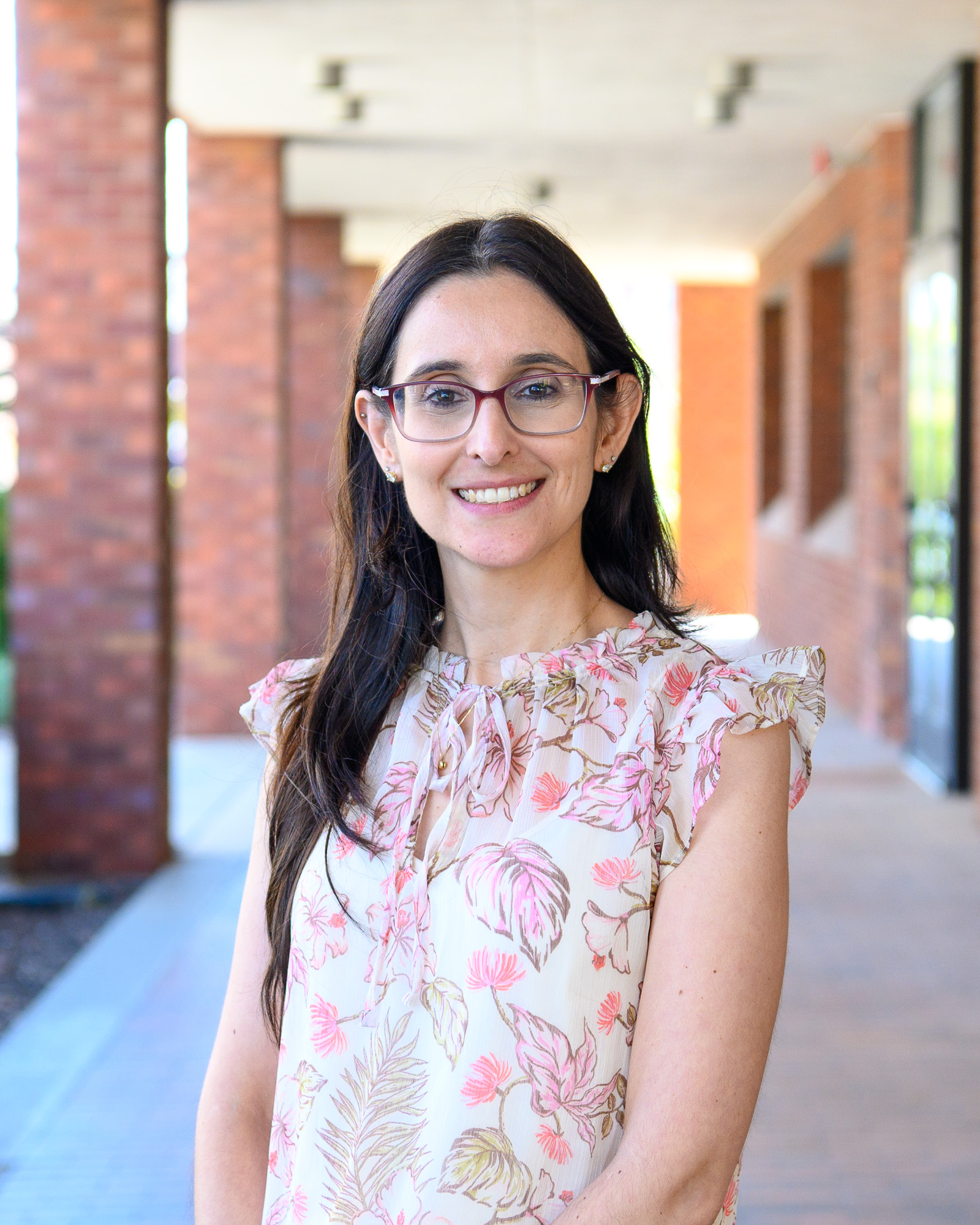
Mariana Mendes Bahia. (Photo by Ethan Simmons)
How was your first year at the Department of Speech and Hearing Science here at AHS?

Mariana: My first year was a period of growth and adaptation as I became familiar with the university and the Department of SHS. I have been fortunate to receive consistent support from colleagues and departmental staff, which greatly eased this transitional period and helped me navigate new academic and administrative environments.

This year was also dedicated to establishing my laboratory, the Neuro+Swallowing Research Lab, and laying the foundation for my future research program. Setting up the lab allowed me to plan my next steps, define research priorities, and begin shaping a trajectory that aligns with my long-term academic goals, while learning to adapt to the challenges and opportunities of a new institutional setting.

When did you first become interested in studying swallowing physiology and disorders, and why have you stuck with that topic in your research?

My initial interest in swallowing developed during my specialization in speech-language pathology in neurology, when I had the opportunity to conduct swallowing assessments and provide treatment for individuals with swallowing disorders, known as dysphagia, related to neurological diseases.

I was fascinated by the complexity of the swallowing process—something we do countless times a day without even thinking about it. What intrigued me most was how such an automatic act relies on the intricate coordination of more than 30 muscles (and many other structures), several nerves, and brain structures. The interaction among all the swallowing structures, along with the brain and breathing, felt like solving puzzles, and this challenge sparked my curiosity and passion for learning more about the mechanisms behind swallowing and how to best support patients with these difficulties.

As a clinically trained speech-language pathologist, I have observed the devastating impact of swallowing disorders on individuals and their families. This experience has motivated me to integrate my clinical expertise and research background in the investigation of swallowing physiology, particularly the interaction between brain-swallowing and breathing-swallowing, to advance rehabilitation approaches that enhance swallowing ability, improve patient care and enhance the quality of life for individuals with dysphagia and their families.

Bahia in her office at the Speech and Hearing Science building.
You’ve described dysphagia as an “invisible” disorder. For the folks you’ve worked with, how does dysphagia impact their quality of life?

Swallowing is a critical process for life. We need to eat and drink for adequate nutrition and hydration. However, we also eat and drink for pleasure and comfort. Eating is a highly social activity. Therefore, the impacts of swallowing disorders or dysphagia are not restricted to the physical health domain, such as inadequate food or liquid intake, resulting in malnutrition, dehydration, or unintended weight loss.

Individuals with dysphagia face psychological, emotional, and social impacts, including fear of eating, embarrassment, loss of enjoyment when they cannot eat or drink certain foods, and reduced social participation in cultural events or family gatherings where eating is central. The limited ability to share a meal may weaken family and community bonds.

Which therapeutic interventions can work for those living with dysphagia?

Therapeutic interventions for dysphagia aim to improve swallowing safety—preventing food or liquid from entering the airway—and efficiency: ensuring adequate passage of food from the mouth to the stomach. Importantly, interventions are tailored to individual needs and target specific impairments evident in each person. Interventions may include compensatory strategies, such as head adjustments and dietary modifications, to reduce the risk of airway invasion, as well as rehabilitative exercises to strengthen the swallowing muscles, improve the movement of swallowing structures, and enhance the coordination of the swallowing process. Additionally, rehabilitative exercises can be paired with other therapeutic modalities, such as neuromuscular electrical stimulation and brain stimulation.

Editor’s note:

To reach Mariana Mendes Bahia, email mmbahia@illinois.edu.

 

Related news

2023 SHS Awards


Related news

SHS’ Rispoli retired from academia, but not done educating


It really should not surprise anyone that someone who grew up in Brooklyn, N.Y., had an interest in languages. After all, Brooklynese is its own special code, spoken by millions.

So, the fact that Matt Rispoli—Illinois professor by way of Marine Park (a neighborhood way at the south end of Flatbush Avenue and home of Nathan’s, Coney Island and Buddy’s Fairyland)—ended up as an academic researcher whose expertise is developmental psycholinguistics makes perfect sense.

Rispoli—who recently retired after four decades in academia—credited his teachers, starting with Judith Marcus, his Spanish teacher at Madison High, and primarily his professors at Hunter College in New York, for influencing his interest in linguistics.

“When I got to Hunter, they had a bunch of great teachers, and I remember them really well,” he said in an accent that gives away his birthplace. “A guy named Robert White, (and also) Tamara Green. They taught Greek and Latin. Best of all was Ralph Ward. The stuff he knew was incredible. I’m lucky I got a chance to study with the guy.

“Those were my influences. Their enthusiasm for language inspired me.”

After graduating from Hunter, Rispoli got his master’s degree in Library Science at Queens College and worked as a librarian for four years in New York, including at the Brooklyn Public Library from 1978-79. 

But his love for language kept calling and he answered, receiving a master’s degree in linguistics at Penn. He followed with a Ph.D. in developmental and educational psychology at Teachers College at Columbia University in New York, and then embarked on an academic career that wound from Cal-Berkeley through the Midwest—the University of Kansas, where he met future wife Pamela Hadley, now the department head of the Department of Speech and Hearing Science at Illinois—to Oklahoma State, Northern Arizona and Arizona State.

Family reasons brought Rispoli and Hadley to Northern Illinois in 1999, and it wasn’t long before the couple/colleagues ended up in Urbana-Champaign.

“It was only a matter of time before someone at Illinois noticed my wife’s career and said, ‘Gee, we’d love for you to come down here,” said Rispoli, who joined the SHS faculty in 2007 as a visiting assistant professor and became an associate professor in 2017.

“I was delighted to move down to a campus where they actually have a linguistics department and great psychology department, but most of all, a department where we get the brightest kids in the state.” 

Hadley and Rispoli have collaborated on dozens of projects and publications and Rispoli enjoyed the work, but at the end of 2022, he felt it was time to step away.

“I’m 70,” he said when asked why he retired. 

But he had no desire to sit on his couch all day or go play golf.

“After you retire you begin to say, ‘What can I give back?’ I have the time. I have the passion.”

With that time and passion, Rispoli expanded on the Sentence-Focused Framework project created by him and Hadley. The pair developed the Sentence-Focused Framework to build a bridge between early vocabulary and grammar interventions for toddlers and preschoolers with language disorders.

The Sentence-Focused Framework is an approach to language intervention that helps toddlers produce more diverse simple sentences, Rispoli said. 

“Then in retirement, I learned how to animate and create films,” he said. “Now I can actually give expression to these ideas, visualizations that I had while I was lecturing that never came through.”

Rispoli developed a YouTube channel also called the Sentence-Focused Framework, uploading a series of 24 videos that explore language, language development and language intervention. The intended audience is students of language development, parents of young children and professionals involved in early intervention. Rispoli encourages instructors to use the videos in class. 

“It (the YouTube channel) really comes off of my experiences teaching (SHS 320) which is language development. In 320, we couldn’t really be sure of the student’s background and how much they understood or knew. We knew we needed to augment. But I never had enough time as an instructor to augment, to really build up the teaching materials

Rispoli sees Sentence-Focused Framework as addition to the college curriculum, and has just finished a website that houses the videos and other tools.

Whatever the future for that project, it’s clear retirement hasn’t slowed Rispoli, who sees it as just another phase of life.

“First chapter I was a librarian,” he said with a laugh. “Second chapter I was a Ph.D. Third chapter I’m an educator of sorts. … who really speaks Adobe Premiere.”

Editor’s note:

To reach Vince Lara-Cinisomo, email vinlara@illinois.edu.
 

Related news

Message from Professor Pamela Hadley, Head


Welcome to the Spring 2023 issue of the SHS E-News! As we come to the end of another academic year, I am happy to report that students and faculty in the Department of Speech and Hearing Science continue to thrive, to provide outstanding clinical services to individuals in our local community and throughout the state, and to make important contributions to the advancement of knowledge in our field.

We have also begun celebrating our 50th anniversary. The Department of Speech and Hearing Science was formally established at the University of Illinois in 1973. Throughout this year, we will honor the people who formed the foundation of the department as well as contributions to pioneering research and leadership in the profession with a series of articles. We hope you’ll join in our celebration. Watch for new articles during the first week of each month and visit our 50th anniversary website for more information.  

In this issue, we introduce you to three faculty who are doing important research in the area of speech perception in noise. Mary Flaherty, Dan Fogerty, and Ian Mertes are breaking new ground as they work to identify why children and adults have difficulty hearing in noisy backgrounds and how they can best be helped. I am so proud to lead a department in which innovative research is the norm. It not only advances the field, but also ensures that our students are on the cutting edge of knowledge.

We say goodbye to Associate Professor Matt Rispoli and congratulate him on his retirement after 16 years with the University of Illinois Urbana-Champaign. Matt devoted his career to the question of how children acquire language. His research focused on early verb learning, the learning of syntax, and the development of incremental sentence production in children. Matt was a recipient of the College of Applied Health Sciences’ Phyllis J. Hill Award, which recognizes outstanding mentoring of undergraduate students. He will be missed!

I also am impressed by the initiative shown by our students to position themselves as leaders within communication sciences and disorders. One of our undergraduate students, Holly Panfil, will spend the summer studying Augmentative and Alternative Communication (AAC) devices after earning a prestigious Fulbright Canada-Mitacs Globalink internship. She will work with Dr. Julie Bouchard at the University of Quebec on a study of AAC devices in the workplace.

In this newsletter, we also highlight the accomplishment of numerous undergraduate and graduate students who have received scholarships and awards this year in recognition of their academic, professional and personal excellence.

Please enjoy reading the newsletter and take pride in knowing that your alma mater is strong and growing!

Pamela Hadley
Professor and Department Head
 

Related news

Threats’ career goal had family inspiration


Travis Threats was recently named one of the recipients of the Honors of Association from the American Speech-Language-Hearing Association (ASHA).

Travis Threats had a clear inspiration for what he wanted to study: his brother.

Threats, who earned his master’s degree from the Department of Speech and Hearing Science in 1984, said he first observed speech therapy when he was eight years old.

“My younger brother, three years younger than me, is autistic,” Threats said. “Autism directly affects communication. Now, some people think, when they hear this, that it’s some beautiful inspirational story, and all of the speech therapists were great, and that’s why I wanted to be like them. Well, it’s the opposite. All the speech therapy in its early years was bad. The social work was bad. The teachers were bad. Even though (my brother) didn’t have any overt behavior issues, my parents would go to the doctor’s office, fill out the information, and the (pediatrician’s) nurse would come out to the waiting room, saying ‘He doesn’t see autistic children.’”

That interaction led Threats to the conclusion that “there was a need. All of my work has been with people in their actual lives because I realized there’s been a disconnect between therapists, and what goals they achieved, and what people with disabilities actual lives are like. For me, it’s a clear-cut (reason to study speech pathology).”

For his work and dedication to the profession, Threats—now professor and department chair of Speech, Language, and Hearing Sciences at Saint Louis University—recently earned Honors of Association from the American Speech-Language-Hearing Association (ASHA). It is the national organization’s highest honor.

Threats got his undergraduate degree at Kansas State University before coming to the University of Illinois for his master’s. At Illinois, he met a man who would have a profound effect on his career.

“I did decide I wanted to work with adults with acquired disorders,” Threats said. “And the person who taught that wasn’t a researcher: Dr. Robert Simpson. He was a very humane man, and he did talk about aphasia and strokes and all that from that broader viewpoint of what they do to people’s lives.”

Simpson, who died in 2019 at 93, was a professor of speech and hearing science at the University of Illinois and also served as director of the department’s speech and hearing clinic. He served on the facial deformity team at Carle Foundation Hospital and eventually was employed by Carle as a speech pathologist after retiring from the university.

“He wasn’t a researcher in a traditional sense,” Threats said. “But his teachings were very much a positive influence on me.”

The ASHA award Threats received recognizes exceptional contributors whose work has enhanced or altered the course of research in the field of speech, language and hearing sciences. In an association of more than 218,000 professionals, only a select number of individuals each year receive this prestigious award.

He understands its significance.

“Three of my professors at U of I have honors from the association. I do remember—as a Ph.D. student (at) Northwestern—going to the first ASHA conference and going to the awards ceremony. And these were the people who wrote the books that I was studying from. These were some of my alums at Northwestern—three or so of those people eventually got honors, too. My own advisor got honors the year I graduated. … I certainly didn’t at the time think that I would be one of those people.”

Editor’s note:

To reach Vince Lara-Cinisomo, email vinlara@illinois.edu.
 

Related news

Department of Speech and Hearing Science
901 South Sixth Street
M/C 482
Champaign, IL 61820
217-333-2230