Rural Health Initiative will bring department’s speech and hearing health expertise to rural Illinois


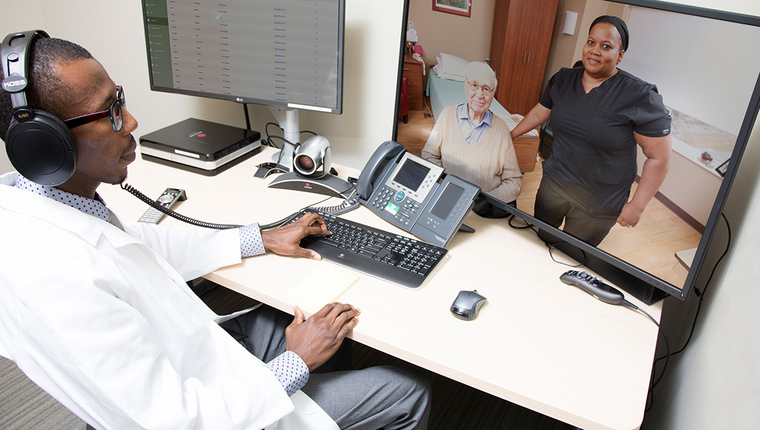
SHS will establish a rural telehealth site in Stephenson County to offer state-of-the-art remote clinical services that residents can easily access (Photo provided)

With a boost from donors, researchers and clinical faculty in the Department of Speech and Hearing Science are collaborating to introduce a new speech and hearing healthcare option for residents in rural areas of northern Illinois. 

Partnering with the Illinois Extension, the department will establish a rural telehealth site in Stephenson County to offer state-of-the-art remote clinical services that residents can easily access. Upon successful testing and initiation, the department will be ready to expand these services to other counties.

The Speech and Hearing Science Rural Health and Telehealth Initiative was developed on a charge from new department head, Professor Georgia Malandraki, after a generous donation for the cause from David Shockey, attorney and two-time University of Illinois graduate from Freeport, Illinois. 

“Our department has a strong history of leading telehealth research and advancing evidence-based practice in our field. I am deeply grateful for the support that made this initiative possible, allowing us to extend our impact and deliver high-quality speech, language, cognitive and hearing care to those who need it most,” Malandraki said.

“By building on our faculty’s expertise, we are also strengthening student training and preparing future clinicians and scientists to serve rural communities.”

Of 102 counties in Illinois, 82 are classified as rural by the state’s Department of Public Health. About 15 percent of Illinois residents reside in rural areas of the state, which are more likely to face healthcare staff shortages and limited access to specialty services. 

“Part of what we’re trying to investigate right now is just what are the needs of the community, and how does that fold in with the opportunities and what we’re already offering,” said SHS Associate Professor Dan Fogerty, who researches speech perception and hearing loss. “With telehealth and remote services, you need to have the platform and infrastructure in order to provide those.” 

For faculty at the Department of Speech and Hearing Science, these telehealth sites will be a chance to implement their ongoing research, outreach and clinical practices around telehealth in a new region. 

The rural health initiative is steered by a task force of research and clinical faculty at Speech and Hearing Science, including Fogerty; Professor Raksha Mudar; Clinical Associate Professor Clarion Mendes, a speech-language pathologist; and Clinical Assistant Professor Sadie Braun, an audiologist. 

“We have a flagship campus with a commitment to our communities. This is a way we can demonstrate that our services extend beyond our campus alone,” said Mudar, who directs the Aging and Neurocognition Lab. “We have built the evidence base—we have the expertise, so now it’s just bringing it all together to offer a more cohesive way to extend that to the community.”

For SHS students, the telehealth sites will provide opportunities to serve individuals in under-resourced areas using the latest remote care technology, broadening their hands-on experience before they become full-time clinicians. 

The project is still early in development, but a crowd-funded campaign helped raise another $2,000 to support the establishment of both telehealth sites. The initiative will build on the teamwork from previous collaborations across the department, including a grant-funded project to create more accurate hearing tests.  

“The nice thing about Speech and Hearing Science at Illinois is that the education, the research and the clinical practice are all integrated,” Fogerty said. “This is an excellent project to demonstrate that.”  

Editor’s note:

To reach Ethan Simmons, email ecsimmon@illinois.edu.
 

Related news

Illinois researchers aim to develop more realistic hearing tests to improve clinical outcomes


Sadie Braun, left, is working to develop more accurate and meaningful hearing assessments (Photo by Brian Stauffer)

Imagine sitting in a busy café, struggling to follow a conversation as voices and background clatter blend together. For many people with hearing loss, this is a daily challenge—yet traditional hearing tests, conducted in silent rooms with isolated tones, fail to reflect these real-world difficulties. At the University of Illinois, a team of researchers is working to bridge that gap by developing more accurate and meaningful hearing assessments that simulate everyday listening environments. 

Sadie Braun, an audiologist and clinical assistant professor in the Department of Speech and Hearing Science in the College of Applied Health Sciences, is the team’s primary investigator and recently received a $30,000 pilot grant from the Center for Health, Aging, and Disability. She is working with Dan Fogerty, an SHS associate professor, on a project titled “Creation of Speech-in-Noise Profiles for Clinical Fitting of Hearing Technologies.” 
 
The project has two goals, the first being to analyze and better understand speech-in-noise testing results from clinical environments. 

“Instead of simply pressing a button when you hear a tone, we’re trying to get more out of tests that already exist which mirror real-world scenarios,” Braun said. “For example, it is fairly common now to play full sentences while background voices are talking at the same time—more like what someone might hear at a party or in a restaurant. We want to use these results to help understand the nuances in what causes understanding-in-noise difficulties on an individual basis.” 

The second goal of the project goes a step further: not just measuring how many mistakes a person makes during a hearing test, but understanding what kind of mistakes—and why they happen. 

“Right now, clinical hearing tests can tell you that someone misunderstood a sentence, but not how they misunderstood it,” Fogerty said. “Our approach focuses on the types of errors people make and the conditions under which those errors occur.” 

By analyzing these mistakes—called error profiles—the team hopes to gain new insights into what’s actually causing the difficulty. For example, one person might confuse similar sounds, like saying “cat” instead of “cats,” which could suggest a problem with sound clarity. Another person might only repeat the second half of a sentence, pointing to a possible cognitive issue like memory or processing speed. 

“We’re identifying patterns across different types of errors,” Braun said. “Then we compare those patterns with results from standard hearing tests to see if there are connections. That could help us predict which patients need which kinds of interventions.” 
 
Data collection will begin in the fall and participants will come from patients who come to the Audiology & Speech-Language Pathology Clinic and have consented to their audio recordings being used for this study. Braun said the tests focus more on adults, primarily those in their 50s and upward. 
 
With those error profiles, the team hopes to use those to improve hearing aid fittings and outcomes for patient satisfaction.  
 
“Different types of errors can have different real-life consequences,” Fogerty said. “Identifying the reasons why someone misunderstands speech will help the clinician identify recommendations to address those specific difficulties.” 

With support from CHAD, the pilot grant will allow Braun and Fogerty to gather foundational data, refine their testing protocols and begin developing detailed error profiles. Their ultimate goal is to translate this information into better hearing aid fittings, more accurate diagnoses and improved quality of life for patients. 

Looking ahead, the team plans to apply for additional funding to expand the project and validate their findings across broader patient populations. 

Braun emphasized the strength of the partnership at the core of this work. 

“This is a true collaboration between research and clinical practice,” she said. “Dr. Fogerty brings deep expertise in auditory research, while I bring the day-to-day clinical experience. Together, we’re approaching the same problem from different angles—and that’s what gives this project real potential to move the field forward.” 

Related news

Fogerty-led research team tackles hearing health disparities with innovative at-home assessment


An Illinois research team will work to implement an at-home assessment for hearing, including a smartphone app (Stock image)

Approximately 37.5 million adults in the United States experience hearing loss. A team from the University of Illinois is working to alleviate barriers in accessibility and affordability to hearing health care.

Dan Fogerty, an associate professor in the Department of Speech and Hearing Science in the College of Applied Health Sciences, recently received two grants to support his project, titled “Empowering Illinois Communities for Better Hearing Health.” The project is focused on improving access to hearing screening through an at-home assessment and focusing on a primary hearing complaint: difficult hearing in noisy environments. 

One grant is from the Chancellor’s Call to Action Research Program. This program aims to empower the university community to address the greatest challenges facing our society and seek new solutions. The second grant, from Campus Research Board, supports the work done to create the self-administered hearing assessment. Total funding from the grants amounts to just under $100,000.

“Current hearing screening methods, which consist of detecting simple tones in quiet, often fail to address real-world challenges,” Fogerty said. “Hearing screening can be improved by more accurately assessing the listening difficulties that people complain about and may be more motivated to address.”

Research for this gap in treatment for hearing in noisy environments has been active for decades, Fogerty said. 

“It involves both technology-focused solutions, such as advanced hardware and signal processing to reduce noise and enhance speech, as well as aural rehabilitative strategies involving education and training,” Fogerty said. “The focus of this project is to help identify the specific challenges that an individual might have when listening in noisy environments in order to customize the collection of strategies that might be most useful for them.”

A team consisting of researchers from the Audiology and Speech-Language Pathology Clinic, the College of Agricultural, Consumer and Environmental Sciences and the Office of the Vice Chancellor of Research and Innovation will develop and implement an at-home assessment, including a smartphone app. Over the course of the project, they will also examine implementation in the lab, the audiology clinic and in communities across the state.

Fogerty said this combined interdisciplinary approach will help them tackle accessibility and affordability issues.

Hearing screening can be improved by more accurately assessing the listening difficulties that people complain about and may be more motivated to address.

Dan Fogerty

Associate Professor

“Our partnership with the audiology clinic ensures the translation of this research into clinical practice. ACES brings expertise in community engagement, specifically through the Illinois Extension offices which will facilitate public education and access,” Fogerty said. “OVCRI contributes research infrastructure and computational expertise through NCSA.”

NCSA, the National Center for Supercomputing Applications, will support the development of a hearing app that will expand access to the innovative hearing assessment. The high prevalence of smartphones allows online and app-based testing to be possible.

Fogerty said addressing hearing disparities is a priority because untreated hearing loss has widespread medical, social and economic consequences. Adults in underserved communities can be far away from hearing centers and often face shortages in hearing services with healthcare providers. Economic barriers, such as travel costs or time away from work, may also interfere with affordability.

“Mobile self-administered hearing assessments, downloadable to a smartphone, will literally put personalized hearing health information at our fingertips,” Fogerty said.

At-home hearing assessments are innovative because they enable advanced hearing care remotely, removing barriers and costs associated with in-person clinic visits.

“These tests can be conducted anywhere at any time,” Fogerty said. “This also increases the likelihood of patient follow-up and compliance with testing recommendations due to the convenience and flexibility of the assessment.”

Hearing aid use has been reported as low as 8.6% among adults with some hearing handicap. Fogerty said there are a variety of reasons for this statistic. 

“Gaps in insurance coverage and perceived social stigma may contribute,” Fogerty said.  “Underestimating hearing difficulties, limited awareness of potential treatment options, or difficulty accessing services are other common reasons. Our self-assessment is designed to address some of these factors.”

Even with some over-the-counter hearing aid options, OTCs are still relatively new and many barriers remain.

“Limited awareness of hearing difficulty or treatment, stigma, out-of-pocket costs [are still factors],” Fogerty said. “OTCs are also only intended for use by adults with perceived mild to moderate hearing loss without other medical conditions.”

The funding for this project will start in July and last one year, with the home-based assessments planned to start in early 2026.  Fogerty anticipates recruiting 200 adults across all study phases, which will include testing in the laboratory, audiology clinic and community.

Related news

‘What Did You Say?’ Understanding speech in noise a common problem


A common complaint that audiologists hear from clients coming in for hearing assessments is difficulty hearing in noisy backgrounds. It’s a problem that affects millions of adults and can become more of a problem with age, but it also affects children and adolescents as well.

While the problem might be common, adequate ways of addressing the problem are not. Effective solutions require a deep understanding of the reasons the problem is occurring. Three faculty in the Department of Speech and Hearing Science—Assistant Professor Mary Flaherty, Associate Professor Dan Fogerty and Assistant Professor Ian Mertes—focus their research in this area with the goal of gaining that deep understanding and finding solutions in order to improve the quality of life of those who struggle with understanding speech in noise.

“If people are unable to hear clearly in noisy environments such as restaurants, it can negatively impact their ability to socialize and communicate in those settings and, ultimately, to enjoy those settings,” Mertes said.

Mechanics are There; Understanding is Not

While some might assume that hearing in noise is a problem of aging, it turns out that children can also have difficulty understanding speech in noisy environments. It’s known that children with normal hearing have fully developed auditory systems by their first birthday, but that their brains take longer—into their teenage years—to develop the ability to process speech in noise effectively. What isn’t known is why this is. That’s what Mary Flaherty wants to find out.

“We know it has something to do with attention and sound-source segregation, separating different sounds in the environment,” she said. “We also know children just need more information than adults. They aren’t as good as adults at putting puzzles together when they are missing pieces. But we don’t really understand what it is that children need to help them.” 

Flaherty’s concern is that children who struggle with understanding speech in complex acoustic environments may fall behind in school. Moreover, the true problem may go undiagnosed and the child labeled negatively by teachers and classmates. And if this is true of children with normal hearing, imagine the extra burden faced by children with hearing loss who experience greater difficulty understanding speech in noise.

Adults use cues such as voice pitch to focus on one speaker in noise and ignore everyone else. Children cannot do that. So what cues can help children? Flaherty currently is investigating talker familiarity. She worked with a graduate student in audiology to develop a game that familiarizes children with a voice while they’re playing. A pilot study in which children played the game 10 minutes a day for five days found that their speech-in-noise perception for that particular voice increased. Flaherty plans to pursue research that tests this phenomenon in the classroom.

This summer, she will collaborate with researchers at Lurie Children’s Hospital of Chicago to investigate hearing-in-noise difficulties faced by children who use hearing aids. Among the issues she will investigate is whether talker familiarity also can help children with hearing loss, which has never before been studied. As she continues her research efforts, Flaherty hopes to identify primary factors that account for the long trajectory of children’s development of speech-in-noise perception, and to use the knowledge to improve hearing in noise, especially for clinical populations. She also collaborates with SHS colleague Pasquale Bottalico on classroom studies that they hope will lead to a method of predicting which children may have difficulty understanding speech in noise, identifying characteristics that they have in common, and recommending effective interventions.

More Cues, but More Potential Deficits with Age

Dan Fogerty focuses on older adults in his studies of how noise interferes with speech processing, how it impacts understanding a message and how it requires listeners to recruit other cognitive and sensory processes to help make sense of it.

A predominant perspective on how noise makes speech understanding difficult is that it exerts two primary effects: energetic masking and informational masking.

“In energetic masking, the noise covers up the speech energy in time and frequency,” Fogerty said. “Informational masking refers to all of the other things that might make it difficult, such as the message or familiarity of a competing talker that can draw your attention.”

Sometimes the noise dominates the signal received by the brain, depriving the listener of information. Speech dominates the signal at other times, and from these glimpses of information, listeners can piece together an interpretation of what is being said. Fogerty’s research uses glimpsing theory to examine what cues are available to the listener at any given time, but also extends the theory to how speech information changes over time.

“Amplitude modulation, the temporal rhythm of speech, is critical for understanding speech,” he said. “We’re finding that if the competing sounds vary similarly to the rhythmic aspects of speech, it can make speech understanding difficult. If we separate out these properties so that noise is varying at a faster or slower rate, then people are better able to glimpse or extract information.”

Fogerty’s primary research populations are individuals who have mild or moderate hearing loss as well as individuals who are aging with the typical sensory and cognitive changes that occur but without dementia or significant cognitive decline. He also tests college-age individuals so that effects related to aging or hearing loss are clearer. One thing he notes is important to remember is that being older doesn’t always mean performing more poorly on speech understanding tasks.

“We have a lot of older adults who do just as well or better than college students on some tasks,” he said. “That’s important for us because we want to know what is preserving their ability to understand speech in noise. What strategies are they using that are particularly helpful?”

His research goals are to contribute to the design of better hearing devices, but also to address issues that might not have a technology solution.

“That’s why we’re so interested in finding out what the abilities are that people bring to the task of listening in noise, and whether certain skills can be sharpened through training,” he said.

The Physiology Behind it All

From animal and human studies, we know that when sound enters the ear, the brain has the ability to fine tune the sound by controlling how the middle and inner ear responds. Animal studies have shown that these responses can help encode sounds in background noise. 

Ian Mertes is studying these top-down mechanisms in young adults with normal hearing to determine if they also help humans understand speech in noise. Both mechanisms rely on the brain stem. One mechanism contracts a muscle, which pulls on a bone of the middle ear, affecting how noise is transmitted through the auditory system. It can reduce the noise. The brain stem also can change how the inner ear amplifies sound, which also can turn down noise. 

“I’m looking at how these two mechanisms, which are reflexes, work together,” Mertes said. “They may work at different frequency regions, the lower frequencies or pitches and the middle frequencies or pitches. Working together, they may help people hear in background noise.”

Using otoacoustic emissions, a clinical audiology test of inner ear function, his studies have shown the physiological mechanisms are correlated with the ability to understand speech in noise. But, he said, it’s complicated.

“It can depend on how we do the physiological measurement, the types of sounds we present to the ears, and the speech perception task,” he said. His current focus on individuals without hearing problems gives him the “best look” at normally functioning auditory systems. “They have the most robust physiological responses and are able to participate in the perceptual tasks, and that can help me create a good template for adapting those measurements when I extend my work to clinical populations.”

Working with Vanderbilt University colleague Ben Hornsby, an associate professor of hearing and speech sciences, Mertes also plans to add another auditory concept called listening effort to the physiological picture of understanding speech in noise. Do individuals with weak top-down reflexes have to put more effort into completing speech perception tasks? What are the consequences of this additional effort?

The in-depth knowledge Mertes is gaining through his research may help explain why some young adults with clinically normal hearing report having difficulty hearing in background noise, another area of interest to him.

Summing up what he hopes will be the outcome of his research program, he said, “I’d ultimately like to make a significant contribution to treatment—strengthening auditory reflexes or simulating them in devices, increasing understanding of messages while reducing the effort it takes to reach that understanding.”

Related news
A Few Minutes With … Dan Fogerty


Editor’s note:

To reach Vince Lara-Cinisomo, email vinlara@illinois.edu.
 

Transcript

VINCE LARA: Hi, and welcome to another edition of A Few Minutes With, the podcast that showcases Illinois College of Applied Health Sciences. I’m Vince Lara and today I’m speaking with SHS associate Professor Dan Fogerty about why he chose Illinois, teaching during a pandemic, and his research on the interaction between speech and noise. Dan, Thanks for being on the podcast. I appreciate it. You’re a Wisconsin guy, but what led you to teach at the University of Illinois?

DAN FOGERTY: I think it can be summarized in probably one word here, and that’s opportunity. Illinois has a long history of excellence in speech and hearing research and teaching and that tradition continues today. I see Illinois as a place where I can grow my research program.

I can attract high quality students and interact with them, as well as interact with experts who share related interests. Both within the departments and across campus. And so I think there’s a real collaborative atmosphere here at Illinois that I think is both important and rewarding.

VINCE LARA: Dan, did you always want to teach?

DAN FOGERTY: So I started out my career as a speech language pathologist. So the clinician who was focused in helping people attain functional skills for communication. And in many ways therapy is a form of teaching, although at the time I certainly didn’t think of myself directly as a teacher. The times that I felt most successful when I think back, are when I’ve helped someone overcome a challenge that they’ve had and in order to do something that they value. It has often been in the form of helping someone gain knowledge or skills to help them do something. And this happens both inside and outside the classroom where I have the opportunity to do just that.

So I think I am doing exactly what I’ve always wanted to do but I didn’t always know what to call it, what career to find it in, or even if I should call it teaching, but it certainly is.

VINCE LARA: What’s teaching been like in a pandemic? What sort of challenges have you experienced?

DAN FOGERTY: I’ve been teaching for a number of years and one of the things that I miss the most is the classroom environment. There’s an energy in the classroom where students are working together to solve problems. And while many of those activities or learning objectives can be translated to an online environment, for me, it’s been difficult to create and feel a sense of community. But on the other hand, the pandemic has really forced an opportunity to be creative about teaching. To re-evaluate things that I’ve done before, to seek out resources and how I can do things better. So through this process I’ve learned a lot. And I think that many of those tools and resources that have been discovered or created during this time was will still stay around and can still be used to enhance interactivity and engagement of courses, both online and in person in the future.

VINCE LARA: Commonly Dan, I find when I do these interviews, researchers had some sort of experience that they’ve had that inspires their research and I’m wondering what that was for you.

DAN FOGERTY: There have been the experiences that I’ve experienced both as a clinician and really just as an individual with members of my own family, where people have difficulty hearing. That poses significant challenges for them to participate in the life of others.

And this is a very common problem. So nearly one in three people between 65 and 75 have hearing loss. If you go over 75, half of individuals have hearing loss. And that hearing losses associated with cognitive decline later in life as well.

The good news is that hearing loss is also one of the largest modifiable factors for preventing dementia. Modifiable means that we can do something about it. We have the knowledge and the tools now to improve communication and cognitive function later in life. It involves protecting our hearing and it involves using appropriate hearing devices like hearing aids.

And in addition to just hearing loss, made listening environments are complex, they’re challenging. Think about going to a restaurant but there’s a lot of noise, or even trying to type at the TV on in the background. Listening in noisy environments presents even more challenges. Particularly, to those who have hearing loss, but really for anyone, even those who don’t.

Anyone can have difficulty with communication. And so what inspires me is that there is a real opportunity here. An opportunity to address a problem that so many people have difficulty with, to improve our ability to communicate with each other, to prevent cognitive decline. Communication is really central to our human experience and we can do something to increase access to that.

VINCE LARA: My background is communications, and so often in communications we talk about separating the noise from the message in order to facilitate communication. Is that similar to your research on interactions between speech and noise?

DAN FOGERTY: I think this is an interesting comparison. So we can think about noise really coming in two different types. We can think about noise as a purely acoustic signal. So you can think about road noise or the roar of a lawnmower or a hairdryer. And in the presence of that noise it can be hard to understand speech because these noises in the background mask the speech. They cover it up.

But in many cases, the noise that we hear can have its own meaning as well. So let’s say we’re in a lecture hall and we’re trying to listen to someone present but there are a couple of people in the back who are talking. In that context, we can think of that background speeches and noise that covers up what we’re trying to listen to, the presenter. But the people in the back of the room are also communicating real meaningful information.

And so we can also have competition from that meaningful information. So this is a sensory task, listening to speech that is partially masked by some other signal. But it’s also a cognitive task, one where we’re trying to find the message and separated out from competing sources of information. And I think it’s that latter task that we can really draw some parallels here.

So how do you hear the message you are trying to find when there are so many other sources of information that can be competing for your attention.

VINCE LARA: Part of your research looks at factors that predict how people perform in noisy conditions. And I’m wondering, what does that entail?

DAN FOGERTY: So it entails these sensory abilities. The ability to detect, to process sound, to detect moments in time when the intended speech pops out above the background noise. But it also entails certain cognitive and linguistic abilities. So this can be the ability to attend the message, to inhibit competing messages, to hold information in memory, and be able to use that information to facilitate future understanding and processing.

And these abilities can also interact with our previous experiences and skilled language as well.

VINCE LARA: Dan at an R1 university, research is always going on. You always have that next project you’re working on while you’re working on projects that are currently in front of you. So what’s next in your research pipeline?

DAN FOGERTY: So we already know a lot about the types of conditions that make it difficult for us to understand speech, and general principles that we can employ to improve understanding for groups of listeners. But people can have challenges understanding speech for different reasons and therefore, they can make different errors in understanding the message. And those errors have real consequences in terms of the actions someone might take.

So you can think about someone misunderstanding health information from their doctor. So I’m interested in identifying not just if someone is having difficulty, but why they’re having difficulty. How it might be different from someone else who might have the same level of performance, in terms of understanding it but they’re having different errors, different underlying sources that are resulting in that difficulty.

And this can lead to potentially different consequences for the individual. So I want to be able to characterize those individual differences and really look at what we can do to intervene on an individual level to maximize speech understanding.

VINCE LARA: My Thanks to Dan Fogarty. For more podcasts on Illinois College of Applied Health Sciences, search A Few Minutes With on iTunes, Spotify, iHeart Radio, radio.com and other places you get your podcast fix. Thanks for listening, and see you next time.

Related news

Department of Speech and Hearing Science
901 South Sixth Street
M/C 482
Champaign, IL 61820
217-333-2230