Illinois researcher earns NIH subaward to advance cochlear implant technology


Photo by caption

Justin Aronoff, an associate professor in the Department of Speech and Hearing Science in the College of Applied Health Sciences at the University of Illinois Urbana-Champaign, has received a subaward on a Phase I Small Business Innovation Research grant from the National Institutes of Health and the National Institute on Deafness and Other Communication Disorders. The project, led by Vortant Technologies, focuses on a novel approach called “spatially transparent binaural beamforming” that improves on noise reduction techniques in cochlear implant processors.

Cochlear implants have transformed the lives of hundreds of thousands of people worldwide, offering a sense of sound to individuals with severe to profound hearing loss. Yet despite their effectiveness, users often face significant challenges in noisy environments such as restaurants, classrooms or crowded public spaces. Traditional technologies designed to filter noise can unintentionally distort spatial cues—the subtle differences in sound loudness and timing that allow people to locate and separate sounds in space. This distortion makes it harder for cochlear implant users to orient themselves in noisy situations, diminishing the devices’ usefulness in the real world.

The newly funded collaboration between Aronoff’s research group at Illinois and Vortant Technologies aims to solve this problem by advancing a promising new strategy in signal processing. Beamforming, the core technology under study, works by amplifying sounds coming from a specific direction—typically the person a listener wants to focus on—while suppressing sounds from other directions. While beamforming is not new, most existing approaches compromise spatial awareness. Vortant’s innovation, however, is a “spatially transparent” beamformer, meaning it not only improves speech perception in noise but also preserves the spatial cues that are critical for natural hearing.

“Beamforming helps improve speech perception in noisy environments by allowing a microphone to focus on sound from a specific location,” Aronoff said. “The problem with most beamformers is that while they enhance speech, they distort spatial cues, making it difficult to tell where different sounds are coming from. Vortant has been developing a beamformer that overcomes this tradeoff, both improving speech perception and preserving spatial information.”

Aronoff’s lab will play a key role in testing this technology. As the Illinois subawardee, he is responsible for designing and conducting behavioral studies with cochlear implant users. These studies will assess whether the new algorithm delivers on its promise to improve speech understanding in noisy conditions while maintaining the ability to detect where sounds originate. All participant testing will take place in Aronoff’s laboratory at Illinois, where his team has extensive experience conducting similar research.

Being able to follow conversations in noisy environments is one of the biggest challenges they face, and we hope this technology can make a meaningful difference in their everyday lives.

Justin Aronoff

SHS Associate Professor

Vortant Technologies specializes in developing assistive technologies that increase accessibility for people with disabilities. Aronoff first connected with the company through Phil Schaefer, Vortant’s chief scientist, when the two served together on an NIH SBIR review panel. Their shared interest in advancing assistive hearing technologies led to discussions of collaboration, eventually resulting in this funded project. Alongside Aronoff’s group on the Urbana-Champaign campus, a second subaward was issued to Ryan Corey at the University of Illinois-Chicago, expanding the collaboration across campuses.

For Aronoff, the project builds on a long-standing line of research aimed at maximizing the benefits of binaural hearing—the use of both ears—in cochlear implant users. His laboratory has previously been supported by an NIH R01 grant from the NIDCD, now in its fifth year, which investigates how cochlear implant users process spatial hearing cues. That project has already generated four peer-reviewed articles, additional manuscripts under review, and presentations at major national and international conferences. A renewal application for the R01 is currently under consideration, demonstrating the momentum and sustained impact of his research program.

The new SBIR project represents an opportunity to translate fundamental scientific findings into real-world applications. By validating the effectiveness of Vortant’s beamforming algorithm in a controlled laboratory setting, Aronoff’s group will help lay the groundwork for technology that could ultimately be integrated into commercial cochlear implant processors. If successful, the innovation has the potential to make daily listening situations—such as following conversations in a busy café or hearing a teacher in a lively classroom—more manageable and less exhausting for cochlear implant users.

For Aronoff, the potential impact is deeply motivating. “Our ultimate aim is to improve speech perception in noise for cochlear implant users,” he said. “Being able to follow conversations in noisy environments is one of the biggest challenges they face, and we hope this technology can make a meaningful difference in their everyday lives.”

The NIH’s SBIR program is specifically designed to support early-stage research and development conducted by small businesses, often in collaboration with academic partners. By fostering these partnerships, the program seeks to accelerate the translation of innovative ideas into marketable products that can benefit patients and society. The Phase I award to Vortant Technologies and its collaborators at Illinois and UIC exemplifies this mission, advancing cutting-edge science with clear pathways toward clinical application.

As the project progresses, Aronoff and his team will collect data to determine whether the algorithm meets its dual goals of enhancing speech perception and preserving spatial hearing. If the Phase I studies are successful, the team hopes to pursue a Phase II SBIR award, which would provide more substantial funding to refine the technology and move closer to commercialization.

For cochlear implant users, the promise of better hearing in noise could be life-changing. For Aronoff and his collaborators, the new grant marks an important step toward bridging the gap between laboratory research and the lived experiences of people who rely on hearing technology.

Editor’s note:

To reach Vince Lara-Cinisomo, email vinlara@illinois.edu.

 

Related news

Health study involves adults with Down syndrome ‘every step of the way’


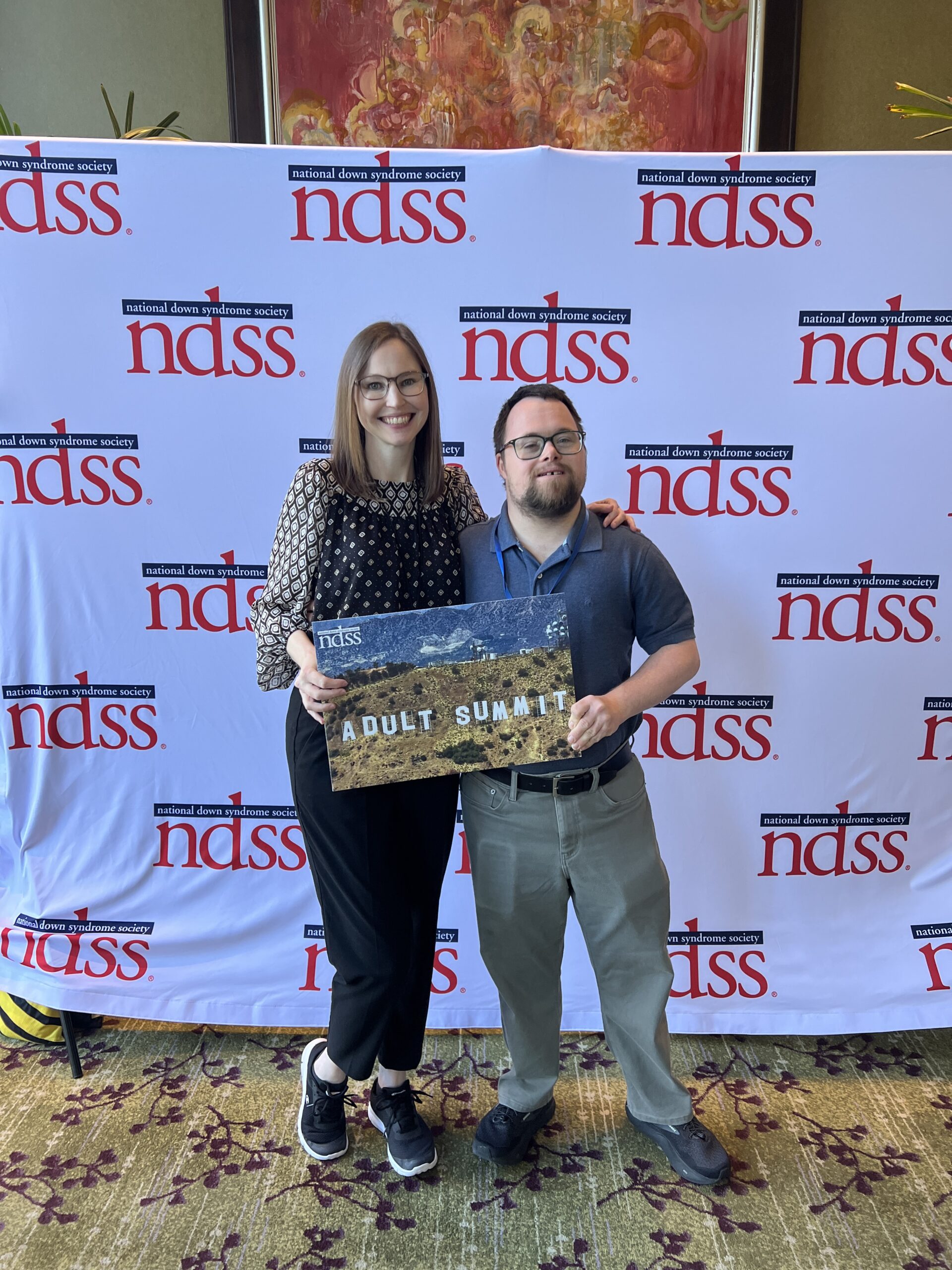
Marie Moore Channell and Joey Kane at the National Down Syndrome Society Adult Summit. (Provided)

The transition to adulthood can be a challenging phase for people with Down syndrome, as resources built to support them in their youth and in school begin to dry up.

Marie Moore Channell, associate professor of Speech and Hearing Science at the University of Illinois Urbana-Champaign, is the lead investigator on a new study funded by the National Institutes of Health, which will collect the direct perspectives of young adults with Down syndrome and develop community resources to support their social, mental and physical well-being.

Unlike any previous study on the topic, this one has a steering committee of adults with Down syndrome who’ve helped develop the direction of the study “every step of the way.”

“We realized that the research as a whole is missing that perspective from individuals with Down syndrome themselves,” Channell said. “It’s really a humbling experience as a researcher to take a step back and not say, ‘these are the topics missing in the literature.’ This time, we said, ‘you tell us.’”

Channell and her co-investigators, University of Nebraska-Lincoln’s Susan Loveall and Vanderbilt University’s Meghan Burke, have obtained a two-year, $446,096 grant from the National Institute of Child Health and Human Development for their study, titled “Developing and implementing community based participatory health research with young adults with Down syndrome.”

The research team will cast a wide net, conducting one-to-one Zoom interviews with adults with Down syndrome across the U.S. to better understand their health concerns, and how to best support them.

The study emerged from a separate survey the professors had sent out to caregivers of individuals with Down syndrome, which sought to identify the gaps in support that occur once they reached young adulthood. Adults with Down syndrome tend to live with a caregiver until age 50.

“Families tell us some version of the same thing, over and over: that the supports they were receiving when they were younger and in the schools, are taken away when they’re older,” Channell said.

They decided the topic warranted further investigation. But first, Channell and her team used their networks to form a steering committee with 12 young adults, all of whom have Down syndrome.

One of those steering committee members is Joey Kane, a 30-year-old from Seattle who met Channell at the National Down Syndrome Society Adult Summit a couple years ago. Channell described some of the participatory research she was interested in doing, and Joey was all ears.

“I like to help make a difference,” Kane said. “It’s giving my voice to be heard, and advocating not just for me, but for everyone else who has a disability.”

While the lead researchers have put the study in motion, the steering committee has met with them at least once a week over video calls, sometimes twice to accommodate members living in different time zones.

The health topics they’ve focused on, Channell said, have ranged from securing employment and community living, to improving physical health and self-advocacy skills.

All those priorities resonate with Kane. He lives in an apartment about a mile away from his parents’ house and has two jobs: he serves dinner at the cafeteria in a local nursing home and works the front desk at the Down Syndrome Center of Puget Sound, where he also helps teach in the center’s adult program.

Kane has enjoyed meeting the rest of the committee and learning about their perspectives on health topics. He credited Channell and the other study organizers for making sure everyone is represented.

“What’s really good about Marie and the people doing the study, is they can tell who hasn’t talked yet,” he said. “It makes me happy that everyone’s participating. If everyone participates, we’re going to have a good study.”

We realized that the research as a whole is missing that perspective from individuals with Down syndrome themselves.

Marie Moore Channell

Associate Professor, Speech and Hearing Science

Input from the steering committee has shaped the study in critical ways. For one, at the suggestion of the committee, the community resources will likely be geared for professionals who support individuals with Down syndrome, such as healthcare providers, case managers and job coaches.

The virtual interviews will be one-one-one video calls, rather than online surveys. Participants will be able to see questions ahead of time and bring pictures to illustrate their ideas.

“It is a technique we learned about in looking at the research, and that’s one the [steering committee] gravitated toward. It’s called ‘photovoice,’ and it’s been used in similar kinds of community participatory research methods,” Channell said.

The resources could take several forms, but what Channell knows for sure is she’ll be “working with this group every step of the way.” 

“I’ve never done this kind of work before, and it’s been a big learning curve, but really refreshing. Because it feels like we can make an impact a lot faster,” Channell said. “I still highly value the other kinds of research I’ve done, but this is something where it’s built into the project to implement into the community by the end.” 

The investigators will put together a “researcher’s toolkit,” compiling the successful practices and challenges of this participatory research. The team is currently hiring some of the steering committee members as co-researchers, who will be trained to help conduct the one-on-one interviews and take part in day-to-day research tasks.

“I’ve learned so much, and I see the value of connecting with the community, building a relationship and working with them before their research study is designed—not imposing your research questions on the community, we’re so used to doing that,” she said.

“It’s really challenging to change that, but I think it’s what we all should be doing more and more of as researchers.”

Editor’s note:

To reach Marie Channell, email channell@illinois.edu
Channell runs the Intellectual DisAbilities Communication Lab at Illinois. Visit their website.
 

Related news

Illinois researchers aim to develop more realistic hearing tests to improve clinical outcomes


Sadie Braun, left, is working to develop more accurate and meaningful hearing assessments (Photo by Brian Stauffer)

Imagine sitting in a busy café, struggling to follow a conversation as voices and background clatter blend together. For many people with hearing loss, this is a daily challenge—yet traditional hearing tests, conducted in silent rooms with isolated tones, fail to reflect these real-world difficulties. At the University of Illinois, a team of researchers is working to bridge that gap by developing more accurate and meaningful hearing assessments that simulate everyday listening environments. 

Sadie Braun, an audiologist and clinical assistant professor in the Department of Speech and Hearing Science in the College of Applied Health Sciences, is the team’s primary investigator and recently received a $30,000 pilot grant from the Center for Health, Aging, and Disability. She is working with Dan Fogerty, an SHS associate professor, on a project titled “Creation of Speech-in-Noise Profiles for Clinical Fitting of Hearing Technologies.” 
 
The project has two goals, the first being to analyze and better understand speech-in-noise testing results from clinical environments. 

“Instead of simply pressing a button when you hear a tone, we’re trying to get more out of tests that already exist which mirror real-world scenarios,” Braun said. “For example, it is fairly common now to play full sentences while background voices are talking at the same time—more like what someone might hear at a party or in a restaurant. We want to use these results to help understand the nuances in what causes understanding-in-noise difficulties on an individual basis.” 

The second goal of the project goes a step further: not just measuring how many mistakes a person makes during a hearing test, but understanding what kind of mistakes—and why they happen. 

“Right now, clinical hearing tests can tell you that someone misunderstood a sentence, but not how they misunderstood it,” Fogerty said. “Our approach focuses on the types of errors people make and the conditions under which those errors occur.” 

By analyzing these mistakes—called error profiles—the team hopes to gain new insights into what’s actually causing the difficulty. For example, one person might confuse similar sounds, like saying “cat” instead of “cats,” which could suggest a problem with sound clarity. Another person might only repeat the second half of a sentence, pointing to a possible cognitive issue like memory or processing speed. 

“We’re identifying patterns across different types of errors,” Braun said. “Then we compare those patterns with results from standard hearing tests to see if there are connections. That could help us predict which patients need which kinds of interventions.” 
 
Data collection will begin in the fall and participants will come from patients who come to the Audiology & Speech-Language Pathology Clinic and have consented to their audio recordings being used for this study. Braun said the tests focus more on adults, primarily those in their 50s and upward. 
 
With those error profiles, the team hopes to use those to improve hearing aid fittings and outcomes for patient satisfaction.  
 
“Different types of errors can have different real-life consequences,” Fogerty said. “Identifying the reasons why someone misunderstands speech will help the clinician identify recommendations to address those specific difficulties.” 

With support from CHAD, the pilot grant will allow Braun and Fogerty to gather foundational data, refine their testing protocols and begin developing detailed error profiles. Their ultimate goal is to translate this information into better hearing aid fittings, more accurate diagnoses and improved quality of life for patients. 

Looking ahead, the team plans to apply for additional funding to expand the project and validate their findings across broader patient populations. 

Braun emphasized the strength of the partnership at the core of this work. 

“This is a true collaboration between research and clinical practice,” she said. “Dr. Fogerty brings deep expertise in auditory research, while I bring the day-to-day clinical experience. Together, we’re approaching the same problem from different angles—and that’s what gives this project real potential to move the field forward.” 

Related news

Pamela Hadley honored with Stenberg Endowed professorship


Pamela Hadley, center, with faculty and staff of the Department of Speech and Hearing Science (Photo by Craig Pessman)

The daughter of a farmer in rural Illinois, Pamela Hadley had no “schema” for becoming a university professor. But a high school career filled with self-expression helped guide her toward an illustrious academic career that was culminated with a top honor.

Hadley, the head of the Department of Speech and Hearing Science and a professor, was appointed as the inaugural Charles and Kay Stenberg Endowed Professor in Disability Research in a ceremony on April 30.

The appointment is a testament to Hadley’s decades-long dedication to advancing the science of language development in young children, particularly those with developmental language disorder, said Cheryl Hanley-Maxwell, dean of the College of Applied Health Sciences.  

“Pam Hadley has made significant contributions to language science through highly regarded translational research, mentored numerous students into clinical and academic careers, and benefitted the department, university and profession at large through a variety of service activities,” Hanley-Maxwell said.  

The named professorship “is an honor that is accorded to outstanding scholars who have well-established records of excellence in research, teaching, and public engagement,” Hanley-Maxwell added.

The professorship was made possible by a generous endowment from Charles and Kay Stenberg, both Illinois alumni who experienced firsthand the challenges of navigating life with disabilities in an era before the Americans with Disabilities Act. Though they have passed, their legacy lives on through their commitment to disability research and through the continued support of Kay’s brother, Hugh Wishart. 

“Chuck and Kay were passionate about accessibility and believed deeply in supporting research that improves the lives of people with disabilities,” Hanley-Maxwell said.
Hadley also expressed deep gratitude to the Stenberg family, colleagues, students, and family members who shaped her journey. 

“This is rightfully a shared honor,” she said. “I’m profoundly humbled to be named the Charles and Kay Stenberg Professor. The Stenbergs faced and overcame many barriers, and they endowed this professorship to help others do the same.”

Hadley reflected on a life shaped by both personal experience and professional purpose. Raised in rural Henry County, Illinois, she credited her parents for instilling in her a love for inquiry and compassion. Her father, a farmer, encouraged her to solve story problems at dinner. Her mother, a nurse, brought her along on Saturday visits to residents in a skilled nursing facility. “We’d call that volunteering as a conversational partner today,” she joked, noting it was her first exposure to the impact of communication in caregiving.

Her academic journey took her from Augustana College, where she experienced immersive clinical training, to the University of Kansas, where she joined a research preschool program that would shape her scholarly trajectory. 

“It was in that preschool that I first noticed how children with communication disorders were not socially integrated,” she said. That observation led to a research assistantship, publications, and ultimately a Ph.D. in  child language under the mentorship of Professor Mabel Rice.

Pam Hadley has made significant contributions to language science through highly regarded translational research, mentored numerous students into clinical and academic careers, and benefitted the department, university and profession at large through a variety of service activities.

Cheryl Hanley-Maxwell

Dean, College of Applied Health Sciences

Over her career, Hadley has led pioneering longitudinal studies that have reshaped how clinicians and researchers understand early language development. Her work has focused on early identification and intervention for children with Developmental Language Disorder (DLD)—a condition that affects 7 to 10 percent of school-aged children and often goes undiagnosed until it has already begun to impact learning and social development.

She led a groundbreaking multi-site clinical trial, supported by the National Institute on Deafness and Other Communication Disorders, evaluating a parent-implemented language intervention. 

“I’m thrilled to report that the caregiver-implemented intervention resulted in positive effects on vocabulary and grammar,” she said, noting that the professorship would play a critical role in disseminating these findings to clinicians and families.

As head of the Department of Speech and Hearing Science, Hadley led with empathy and pragmatism during the COVID-19 pandemic. She established virtual check-ins, championed remote accessibility, and helped the department resume clinical services quickly and safely. Her leadership style, she said, is grounded in the deep respect she holds for her colleagues and their shared mission: “to promote improved communication and health for individuals with disabilities across the lifespan.”

Throughout the ceremony, attendees were reminded of Hadley’s enduring commitment to education. Undergraduate and graduate students alike benefit from her guidance, both in the classroom and in the lab. As one of the few national experts on early grammatical assessment and intervention, her work translates directly into tools and strategies used by speech-language pathologists and parents.

In concluding her remarks, Hadley acknowledged her most personal source of support—her family. Her husband, Matt Rispoli, a retired SHS faculty member, and their daughters have shared in the journey. 

“They’ve always graciously shared me with my students and my work,” she said, adding that the family’s shared love of hiking serves as a cherished escape from her many professional responsibilities.

As Dean Hanley-Maxwell presented the medallion that accompanies a named professorship, she emphasized what the moment represented: a celebration of achievement, but also a reaffirmation of the university’s mission to foster research that has real-world impact. 

“Pam, your outstanding work has added to the prestige of this college and university,” she said. “We are grateful for and proud of your commitment to helping children with language disabilities get a better start in life.”

Editor’s note:

To reach Vince Lara-Cinisomo, email vinlara@illinois.edu.
 

Related news

Words That Bind


The weekly aphasia communication group is the ‘best hour’ of everyone’s week, one member said. (Photo by Ethan Simmons)

In the days following her stroke, all Mary Moore could remember was two phrases: her name, and Dec. 26, the day she was born. 

A short five months later, Moore was in the Audiology and Speech-Language Pathology Clinic, leading a lively conversation with students at the University of Illinois Urbana-Champaign. She’s now a regular attendee of the Aphasia Weekly Communication Group, a brand new initiative in the Department of Speech and Hearing Science at Illinois. 

“It’s very accommodating to people, and it’s just so, so much fun,” Moore said. “It helps your ability to socialize and get out there when you go back home afterwards.” 

Now that Moore is living with aphasia, a language disorder that limits the comprehension and production of speech, she knows her conversational skills may never return to her pre-stroke fluency. But the camaraderie she experiences each week with the group provides a regular boost to her confidence. 

The aphasia communication group brings master’s degree students studying to become speech-language pathologists together with adults with aphasia for hour-long chats. 

The table topics at the clinic range from basic icebreakers (“Who’s your favorite celebrity? What’s a fun fact no one knows about you?”) to short word games and trivia contests. Each session challenges the participants on their recall of people, places and things, while the students gather valuable insights about how aphasia is experienced in the real world. 

All the students are enrolled in a class, SHS 534 Aphasia and Related Disorders, taught by Teaching Assistant Professor Anna Pucilowksi. Department faculty have been hoping to add a real-life dimension to the class for years, and now, they finally have it. 

Abby Franz, a longtime SLP and instructor at the Illinois clinic, has facilitated the weekly aphasia group since it kicked off in January. 

“Our goal was to make sure the students understood this was an opportunity for the individuals who have aphasia to enhance their communication in a more informal social conversation because individuals who have aphasia often become isolated. They don’t get the same social experience just because of their language impairment,” Franz said. 

“This is an opportunity for them to come together, socialize and interact with other individuals who have aphasia, which they really appreciate—I’m finding that to be very important to this group.”

A New Opportunity

According to the National Aphasia Association, at least 2 million people in the U.S. live with aphasia. The most common cause is from strokes: nearly one-third of the strokes that occur each year in this country, or roughly 225,000, result in aphasia. 

For such a prevalent language disorder, SHS faculty felt their students needed more exposure to understand aphasia more fully. 

 “It was really obvious that our master’s students were not having real-life experience talking to people with aphasia,” Pucilowski said. “For previous cohorts of students, the course material just seemed really theoretical. I can show them videos, but they’re not actually learning what it’s like.” 

Though this aphasia communication group is completely new for the Department of SHS at Illinois, similar conversation groups are common at hospitals and recovery centers across the country, Franz said. An aphasia communication group existed at Carle Hospital in Urbana, but it petered out prior to the COVID-19 pandemic. 

At SHS, the need for more in-person interaction began bubbling further when the department yielded a larger-than-usual cohort of students. Then, the Audiology and Speech-Language Pathology Clinic became certified to accept Medicare clients last spring, bringing in more older adults to the clinic. 

Pucilowski and Franz put together a proposal for the aphasia group in fall 2024, and the plan was quickly accepted. All that was left was to find participants. 

To get the word out, they relied on word-of-mouth and some boots-on-the-ground flyer marketing, mainly in nearby health care facilities. In the first semester, around five regular participants have continued to show and chat with Franz and the students. 

Aphasia manifests in a broad spectrum. On the severest end, clients with aphasia may struggle to communicate a single word or sound, or their comprehension could be significantly impaired. On the milder side, individuals with aphasia may speak quite fluently, Franz said, even if they misuse or mispronounce certain words, or halt as they try to recall the correct phrase. 

This is an opportunity for them to come together, socialize and interact with other individuals who have aphasia, which they really appreciate—I’m finding that to be very important to this group.

Abby Franz

SLP and instructor at the Audiology and Speech-Language Pathology Clinic

In the current aphasia communication group, participants are all on the milder end of the spectrum. More importantly, they’ve gotten along swimmingly. 

“The group’s really pretty fluent. The dynamic’s great,” Franz said. “They all are very unique and have a lot in common and are very interesting individuals. And that was just purely by luck.” 

The ‘Best Hour’ of the Week 

At their Wednesday session before spring break, students and participants in the aphasia communication group were asked to describe their experience with the group in one word. 

Student Michaela Herwig chose the word “blessing.” 

“It’s been really cool learning about them as people,” said Herwig, who’s training to become a clinical SLP. “Because before they had their strokes and before they had aphasia, they’ve lived very cool lives and they still do really cool things now, even though they might have to adapt them in different ways.” 

As the weeks went on, new fascinating biography details kept leaking out from the participants. Many of the participants happen to be world travelers, for example, having spent years living overseas or learning different languages. 

Within Herwig’s class of future speech-language pathologists, word about the aphasia group is starting to spread. 

“We all describe this group as the best hour of our week,” she said. “Being in this group has solidified that this is a population I really want to work with when I graduate.” 

For the students, each hour in the group is an opportunity to improve their clinical writing skills when working with individuals with aphasia and practice the right communication approach with these clients. In the first phase of the aphasia class, students complete a supported communication training where they learn strategies of how best to interact with patients with aphasia. 

When a speaker with aphasia is working to get their point across, subtle nods and nonverbal cues in response go a long way. Sometimes, the students will rephrase a question to make sure everyone’s on the same page or ask the participant to write down the sentence they’re caught on.

“People who have a language disorder, they have full lives and they’re doing their best to recover and get through life,” said Tony Jacobs, a first-year SLP student who was placed in the group. “To see people with aphasia holistically and not just learning about it in class is one of the best parts of this group.”  

In the second part of the aphasia class, students design their own eight-week aphasia intervention program—anything from a book club, to a volunteer group, exercise club or another socially driven way to engage participants. The aphasia communication group provides a hands-on learning experience of what these programs can look like.

“The way aphasia is getting treated nowadays, it’s with what’s called the ‘life participation’ approach to aphasia,” Pucilowksi said. “You don’t just come to a clinic and do some exercises and expect your language to change. You have to situate it in context, and language happens in groups and communities.” 

The Road Ahead

What does recovery look like for a person with aphasia? With the most common cause being a stroke, the severity of the stroke and age of the patient are the main variables. Most patients can expect their fastest language recoveries in the first 3 to 6 months. A year out, progress typically levels off. 

The class, instructors and participants want to keep this aphasia communication group going. (Photo by Ethan Simmons)

Communication groups target the isolation that comes with aphasia, improving the participants’ social health as much as their physical health.  

“If we can improve their life, even if it’s just one of them, if they’re feeling more comfortable socially and we’re enhancing their life, then the goal is met, right?” Franz said. 

With the first semester wrapping up smoothly, the class, instructors and participants want to keep this aphasia communication group going. There are undoubtedly more people in the Champaign-Urbana area with aphasia, and more students in the department eager to learn from the experience. 

“If we can start offering these eight-week programs and groups, and more niche specialty groups, I think that would be great for the students and great fun for the participants,” Pucilowski said. “That would be my dream.” 

From the time she walks into the sessions on Wednesday mornings, Mary Moore can hardly wipe the grin off her face. It’s hard to believe now, but months ago she was on the fence about joining the aphasia group at all. After understanding her diagnosis, she became determined to “do her homework.” 

“I just had to get better. I had to get better,” Moore said. “I just decided I wanted to go, no matter whether it was in winter or whatever, that I wanted to go. So I did.”

Moore feels a weight lifted when she’s back in the room with Franz and the students. Gone are any airs of judgment when she stammers searching for the correct word, only patience and understanding. 

Her advice to any adults with aphasia thinking about joining: “Go for it.” 

“The students are wonderful, and they are very kind. They don’t talk about you, they listen to you and they care about you,” Moore said. “It’s just so good, it’s beyond belief.” 

(Interested in joining the aphasia communication group, or want to learn more about the Audiology and Speech-Language Pathology Clinic? Contact shsclinic@illinois.edu or call 217-333-2205.)

Related news

Department of Speech and Hearing Science
901 South Sixth Street
M/C 482
Champaign, IL 61820
217-333-2230